
Dyson Airblade Models Compared: What's the Difference?
Posted by Anthony DiCicco on Sep 1st 2026
We've sold hand dryers for more than 20 years. During that time, we've learned that specifications tell only part of the story. Restroom traffic, how people interact with the dryer, installation requirements, maintenance, accessibility, and the experience a facility is trying to create can matter just as much.
That's why we don't look at the four Airblade designs as slightly different versions of the same hand dryer.
They solve different restroom-design problems.
Table of Contents
Jump directly to the comparison or model you're researching.
| What Makes an Airblade Different? | Airblade Model Comparison |
| Airblade V HU02 | Airblade dB AB14 |
| Airblade 9kJ HU03 | Airblade Wash+Dry |
| HU02 vs. AB14 | HU02 vs. HU03 |
| Noise & Acoustics | Quick Answers |
What Makes a Dyson Airblade Different?
Dyson didn't become one of the most recognizable names in commercial hand drying by simply putting a different cover on a conventional dryer.
Airblade technology uses high-speed sheets of HEPA-filtered air to physically remove water from the hands. The sensation is noticeably different from standing under a conventional warm-air dryer. Water feels like it is being pulled or scraped from the hands as they move through the airflow.
That's part of what customers are buying when they choose a Dyson.
How the Airblade Changed the Hand Dryer Category
When the original Dyson Airblade arrived, the hands-in design looked and operated unlike the conventional wall-mounted dryers people were accustomed to using. Instead of holding your hands underneath a stream of warm air, you inserted them into the machine and moved them through narrow sheets of high-velocity air.
It created buzz. For many people, that hands-in shape is still what comes to mind when they hear the words Dyson Airblade.
Other manufacturers eventually introduced their own hands-in dryers, and the premium hand dryer market increasingly competed around high-speed drying, accessibility, filtration, energy consumption, acoustics and increasingly sophisticated technology.
But there is still something difficult to put into a specification table: the expectation that a Dyson product should look innovative, feel different and perform like a premium product.
Forget the Model Numbers for a Minute
HU02 = The Workhorse. Compact, familiar hands-under operation, fast drying, dual HEPA filtration and a shallow wall profile.
HU03 = The Efficiency-Focused Airblade. A distinctive hands-under design with Eco and Max operating modes for facilities placing a high priority on energy consumption.
AB14 = The Experience. The iconic hands-in Airblade design. Visually distinctive and unmistakably Dyson.
Wash+Dry = The Architectural Solution. Washing and drying happen at the basin, making installation and sink design part of the decision.
Dyson Airblade Models Compared at a Glance
| Model | Drying Style | Rated Dry Time | Key Difference | ProDryers View |
|---|---|---|---|---|
| HU02 Airblade V | Hands-under | Approx. 12 sec. | Compact 4-inch profile, dual HEPA filters | Our best all-around Dyson |
| HU03 Airblade 9kJ | Hands-under | Approx. 10 sec. Max / 12 sec. Eco | 650W Eco / 900W Max | Choose when energy is the priority |
| AB14 Airblade dB | Hands-in | Approx. 12 sec. | Iconic Airblade drying chamber | Choose when the experience matters |
| Airblade Wash+Dry | At-sink | Approx. 14 sec. | Wash and dry at the basin | Choose when the project is designed around it |
Dyson Airblade V HU02: The One We Recommend Most Often
If you called ProDryers and said, "I want a Dyson. Which one should I buy?", we're probably going to start with the HU02.
For high-traffic restrooms, we like it even more.
The HU02 takes the technology people want from an Airblade and packages it in a form almost everybody immediately understands. Put your hands underneath it, dry them and move on.
That matters in a busy stadium, casino, school, airport, restaurant or entertainment venue. The goal isn't simply to dry hands. The restroom needs to move people through the space without creating unnecessary friction or bottlenecks.
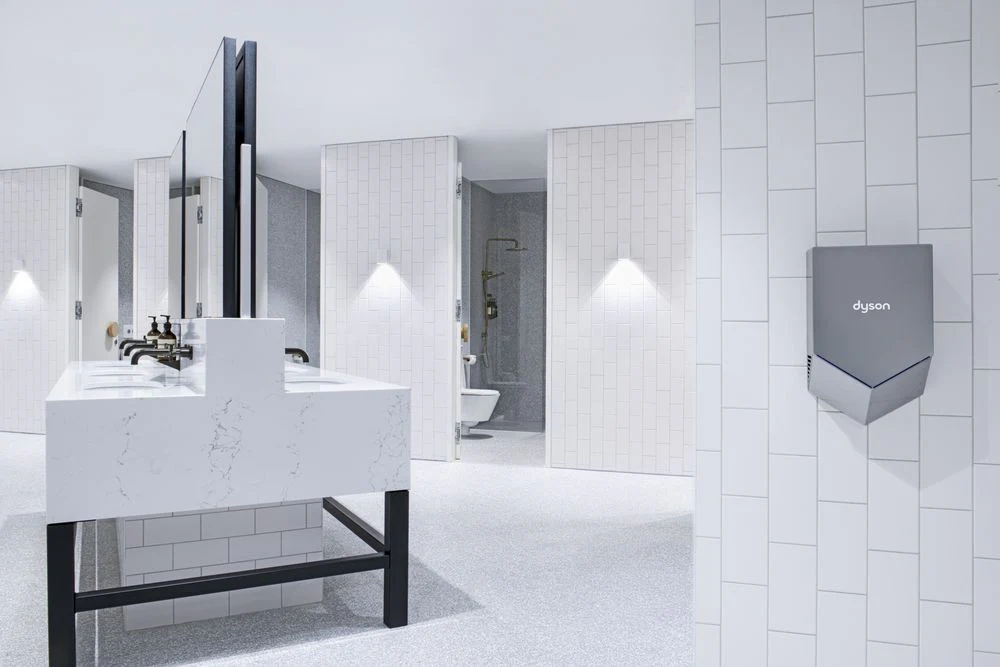
The HU02 projects only 4 inches from the wall, making it particularly attractive for accessibility-conscious installations without requiring the type of recessing needed by deeper conventional dryers. It has a rated dry time of approximately 12 seconds and uses two HEPA filters as standard, one on each side of the machine.
In our view, the HU02 represents one of the most important steps in the evolution of Airblade. Dyson took the fast, filtered drying experience that made Airblade distinctive and packaged it into a compact, familiar hands-under dryer.
Compare Dyson Airblade V HU02 models at ProDryers.
Dyson Airblade dB AB14: The Iconic Airblade Experience
The AB14 is a different animal.
This is the Dyson people recognize.
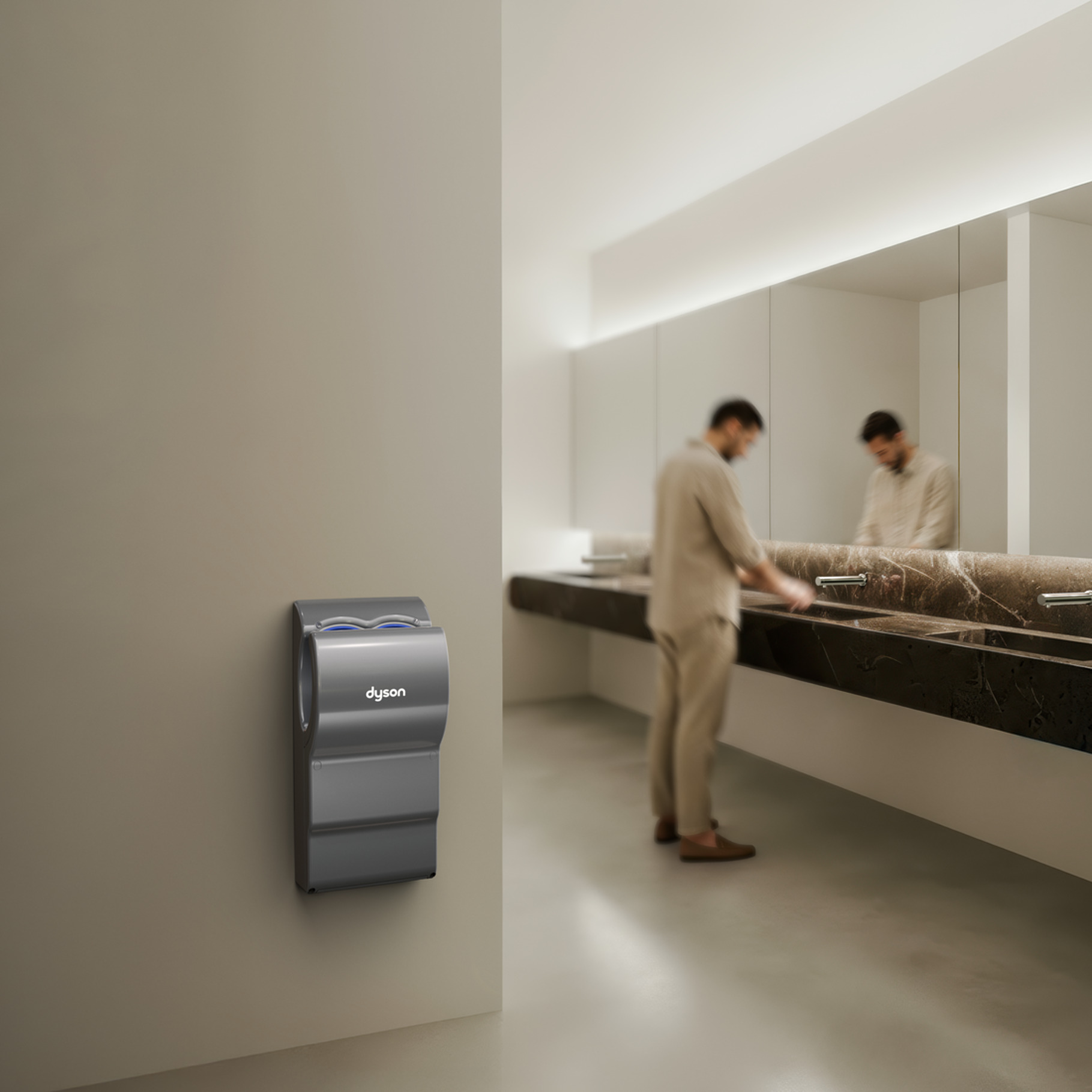
Users lower their hands into the drying chamber and move them through high-speed sheets of filtered air. It's unusual, visually impressive and memorable.
Put an AB14 in a premium restroom and the hand dryer can become part of the experience. The customer isn't simply drying their hands. They're using the product many people picture when someone says "Dyson Airblade."
For a high-end restaurant, executive office, hotel, resort or another facility trying to create a distinctive impression, that has real value.
Why We Don't Automatically Choose AB14 for Extreme Traffic
Over the years, we've seen hands-in Airblades installed in very busy casinos, resorts and other high-volume environments where some users appear more likely to bypass the hands-in design than a familiar hands-under dryer.
There is also a maintenance consideration. Because water is removed from the hands inside the drying chamber, keeping that area looking clean becomes especially important in a heavily used restroom.
That doesn't make the AB14 a bad hand dryer. It means the product needs to match the environment.
Is the Dyson AB14 ADA Compliant?
The AB14 is frequently misunderstood because its body projects farther from the wall than the slim HU02.
That does not automatically mean an AB14 installation cannot comply with ADA protruding-object requirements. Dyson provides installation guidance addressing placement within the cane-detectable range. Accessibility depends on the complete installation, including mounting height, circulation path, surrounding fixtures and applicable requirements.
Compare Dyson Airblade dB AB14 models at ProDryers.
Dyson Airblade 9kJ HU03: When Energy Consumption Leads the Decision
The HU03 is the Airblade we look at when energy consumption moves to the top of the priority list.
Dyson gives the Airblade 9kJ two operating modes: 900W Max and 650W Eco, with rated dry times of approximately 10 and 12 seconds respectively.
That's impressive performance from very little power.
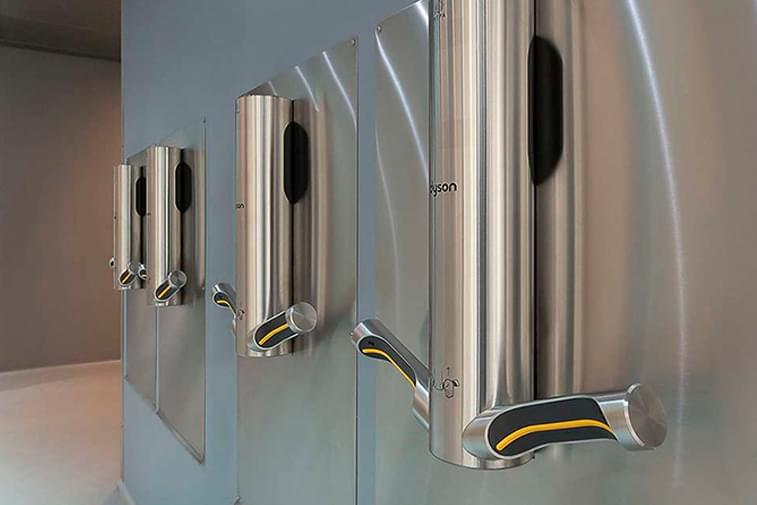
The HU03 also has an unmistakable physical design. There isn't much chance of walking up to one and wondering where your hands are supposed to go.
From our perspective, though, the HU02 remains the easier default recommendation for most customers. The HU03 has a wider physical footprint and doesn't offer the same narrow, conventional form factor we like so much about the HU02.
If a project is evaluating energy consumption across thousands upon thousands of drying cycles, its Eco mode deserves serious consideration. Small differences in energy consumed per cycle can become meaningful at scale.
Compare Dyson Airblade 9kJ HU03 models at ProDryers.
Dyson Airblade Wash+Dry: A Different Conversation Entirely
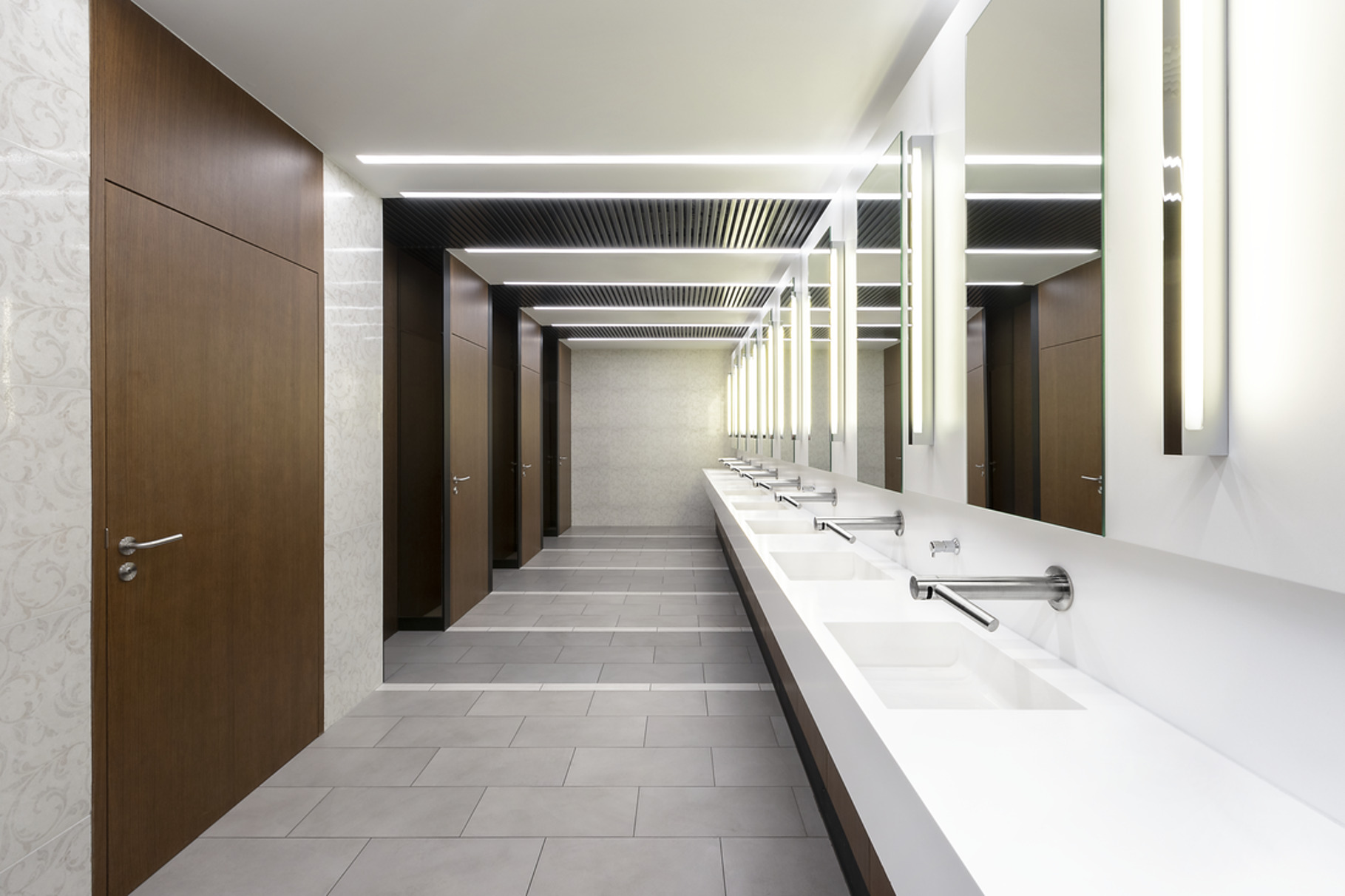
Wash+Dry shouldn't really be treated as just another wall-mounted hand dryer.
It solves a different problem.
The system allows users to wash and dry their hands at the basin instead of walking across the restroom with wet hands.
For the right architectural project, that's a beautiful solution.
But if someone calls us looking for a conventional replacement hand dryer, Wash+Dry usually isn't part of the first conversation.
The installation is fundamentally different. You're dealing with both plumbing and electrical requirements. Sink geometry matters. Faucet positioning matters. The project needs to be designed around the system.
Dyson's installation guidance addresses basin compatibility and geometry because the shape and dimensions of the sink can affect water behavior and splashback.
Compare Dyson Airblade Wash+Dry models at ProDryers.
Dyson HU02 vs. AB14: Function vs. Experience
This may be the most interesting comparison in the entire Dyson lineup.
If you're running a packed facility and restroom throughput is the priority, we choose HU02.
If you're creating a premium restroom where the hand dryer itself contributes to the user's impression of the space, AB14 becomes much more interesting.
| Question | HU02 | AB14 |
|---|---|---|
| How do users dry? | Hands underneath | Hands inside drying chamber |
| Biggest advantage | Compact, intuitive operation | Distinctive Airblade experience |
| Our preferred environment | High traffic and broad commercial use | Premium spaces where design matters |
| Our verdict | Operational choice | Experiential choice |
Neither answer comes from comparing motor speed or reading a specification sheet in isolation. It comes from understanding the facility.
That's why asking "Which Dyson is better?" isn't quite the right question.
Ask what you're trying to accomplish in the restroom.
Dyson HU02 vs. HU03: Which Hands-Under Airblade Should You Choose?
This decision is easier.
Choose the HU02 when you want our preferred all-around Dyson solution: compact dimensions, familiar operation, fast drying, minimal wall projection and dual HEPA filtration.
Choose the HU03 when exceptionally low energy consumption is one of the project's highest priorities and its wider, distinctive design works for the space.
For most customers who ask us to break the tie, we choose HU02.
Are Dyson Airblades Loud?
All high-speed hand dryers make sound. They have to move a significant amount of air very quickly to accomplish their primary job: drying hands fast.
So focusing only on whether a high-speed dryer is "loud" misses part of the issue. The character of the sound matters too.
Dyson has worked on Airblade acoustics as the product line has evolved. But a decibel number still doesn't completely describe what a dryer sounds like in person. Pitch and acoustic character affect how sound is perceived.
Do Dyson Airblades Last?
Our experience has been extremely positive.
Warranty claims have been uncommon relative to the number of Dyson Airblade dryers we've sold. We've also sold Airblades more than a decade ago that are still operating in commercial facilities today.
When warranty support has been required, our experience with Dyson has been that issues are handled promptly and straightforwardly.
That's not a laboratory failure-rate statistic, and we wouldn't present it as one. It's our experience after more than two decades selling commercial hand dryers.
Is a Dyson Airblade Still Much More Expensive?
Not necessarily.
There was a time when Dyson carried a much more obvious price premium over much of the hand dryer market. That gap has narrowed.
Premium models from other manufacturers have become more expensive, particularly when stainless steel covers and specialty finishes enter the equation. Depending on the model and configuration being compared, competing premium dryers can now occupy similar price territory.
There are still projects where another manufacturer makes more financial sense. Large orders involving dozens or hundreds of dryers may qualify for aggressive project pricing, and installation costs can change the economics across an entire facility.
The product you prefer and the project with the lowest total cost aren't always the same decision.
The Biggest Mistake We See When Choosing a Dyson Airblade
It's not buying a bad Dyson.
It's specifying the wrong Dyson for the environment.
The AB14 can look like the obvious choice because it is the iconic Airblade. But in a ski resort, casino, stadium or another facility dealing with bursts of extremely heavy restroom traffic, we'd usually rather have the HU02 moving people through the drying area.
Conversely, if you're designing a lower-traffic premium restroom where creating a memorable experience matters, AB14 can do something HU02 doesn't.
And if an architect wants users washing and drying without leaving the basin, Wash+Dry solves a completely different problem.
More Than 20 Years Selling Hand Dryers
ProDryers has been selling Dyson Airblade hand dryers since the early years of the product line. We've watched Airblade evolve, helped customers compare the different designs, supplied dryers for commercial projects, answered technical questions and supported customers long after the original purchase.
That experience is why our recommendations don't always come directly from a specification table.
Specifications matter. So does seeing how different dryers are actually used.
For more technical information, visit our hand dryer specifications library or our Dyson Airblade review resource.
So, Which Dyson Airblade Is Best?
| Best Dyson for most commercial restrooms | Airblade V HU02 |
| Best Dyson for high-traffic restroom flow | Airblade V HU02 |
| Best when energy consumption is the priority | Airblade 9kJ HU03 |
| Best for the iconic hands-in experience | Airblade dB AB14 |
| Best when drying at the sink is part of the design | Airblade Wash+Dry |
Quick Answers About Dyson Airblade Models
Which Dyson Airblade is best for high-traffic restrooms?
ProDryers generally recommends the Dyson Airblade V HU02. Its compact hands-under design is intuitive for users, has a rated dry time of approximately 12 seconds, uses dual HEPA filtration and is well suited to moving users through busy commercial restrooms.
What's the biggest difference between the Dyson HU02 and AB14?
The HU02 is a compact hands-under dryer designed around straightforward wall-mounted operation. The AB14 uses Dyson's iconic hands-in drying chamber. We generally favor HU02 when traffic flow is the priority and AB14 when the distinctive Airblade user experience is part of the restroom design.
Why choose the Dyson HU03 instead of the HU02?
Choose the HU03 when very low energy consumption is a leading project priority. Its Eco mode operates at 650W, while Max mode operates at 900W. For most general commercial applications, however, ProDryers tends to favor the narrower HU02 design.
Which Dyson Airblade would ProDryers choose?
HU02 all day. Don't waste another second trying to decide. Trust us.
About our perspective: ProDryers has specialized in commercial hand dryers for more than 20 years and is an authorized Dyson distributor. Recommendations in this article combine manufacturer technical information with our experience helping commercial customers compare, purchase and use hand dryers in real-world facilities. Specifications, codes and manufacturer requirements can change. Always confirm current documentation and project requirements before specifying equipment.
Anthony DiCicco is the founder and CEO of Category Five Technologies and ProDryers. Since 2003, he has worked in the commercial hand dryer industry, helping businesses, architects, contractors and facility professionals compare and specify hand drying solutions. His recommendations are based on more than two decades of firsthand product, customer and commercial restroom experience. Meet Anthony and the ProDryers team.