
Handicap Accessibility and ADA Compliance with Hand Dryers
Posted by Anthony DiCicco on Aug 17th 2025
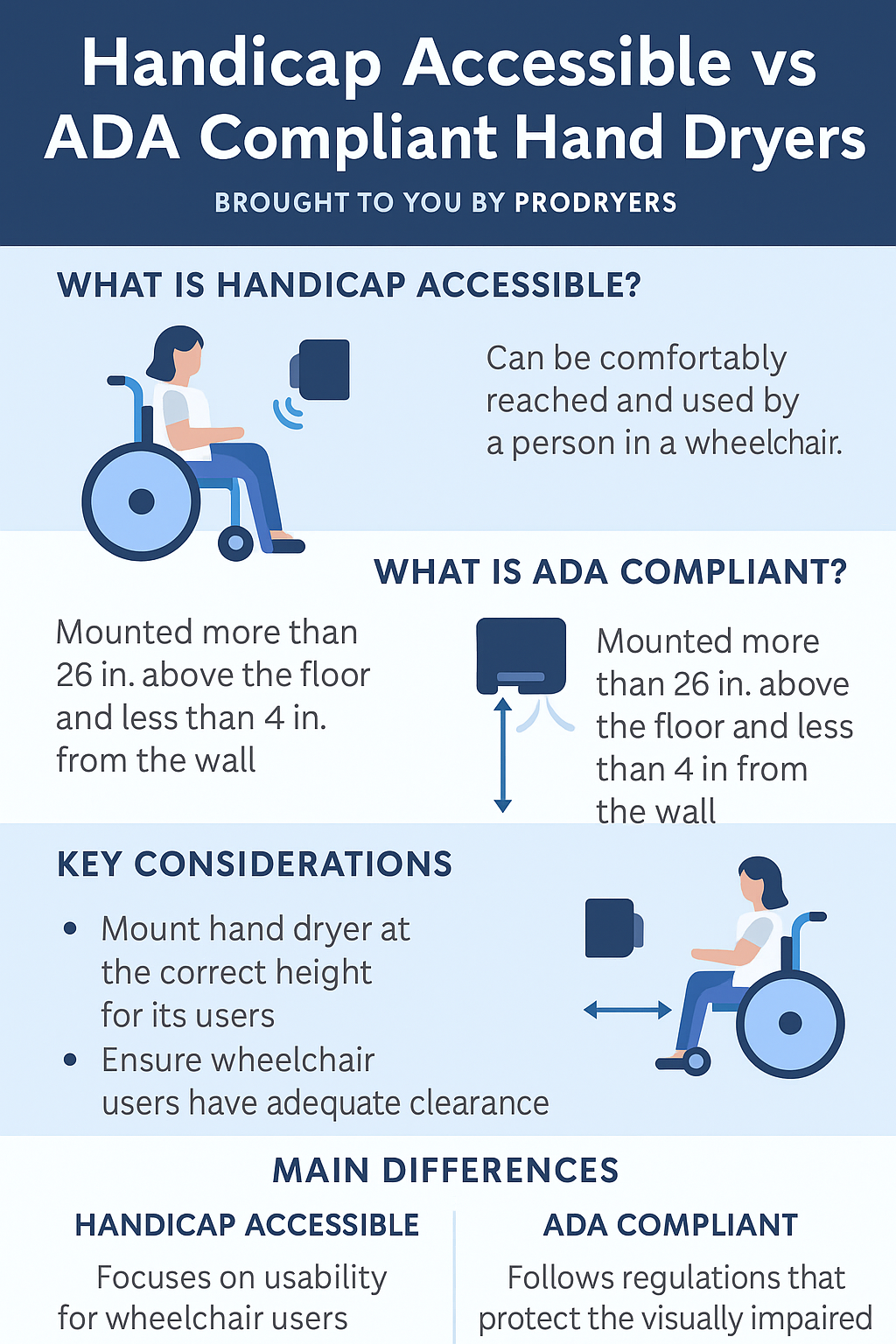
Updated September 2026
At ProDryers, we have helped customers select commercial hand dryers since 2003. One of the most common sources of confusion is focusing on a single dimension, such as mounting height or dryer depth, and assuming that dimension alone determines ADA compliance.
It doesn't. Accessibility needs to be considered as part of the complete installation.
Accessibility & ADA Guide
Jump to the question you need answered.
| What Does Accessible Mean? | What Does ADA Compliant Mean? |
| The 4-Inch Rule | Mounting Height |
| Hand Dryer Examples | Quick Answers |
What Does Handicap Accessible Mean?
"Handicap accessible" is commonly used to describe a hand dryer that can be approached and used by someone with a disability, including a person who uses a wheelchair or other mobility device.
In practice, that means thinking about more than the dryer itself. Important considerations can include:
- Whether the user can approach the dryer
- Available clear floor space
- The location and height of the activation area
- Whether required operable parts are within an accessible reach range
- Whether surrounding fixtures or other objects interfere with access
The ADA Standards use specific technical requirements rather than relying on the general phrase "handicap accessible." That is why we prefer to look at the actual dryer and installation instead of relying on a product label alone.
What Does ADA Compliant Mean for a Hand Dryer?
The Americans with Disabilities Act establishes accessibility requirements for covered facilities. For hand dryer installations, several parts of the ADA Standards can be relevant depending on the installation.
Protruding objects
A wall-mounted dryer may be subject to the ADA's limits on objects that protrude into circulation paths.
Reach ranges
Accessible elements and operable parts may need to be located within the applicable ADA reach ranges.
Operable parts
Where operable parts are required to be accessible, the ADA Standards address their position and operation.
Clear floor space and approach
The user also needs an appropriate accessible approach to the dryer.
This is why saying a dryer is "ADA compliant" based solely on its depth or mounting height can be misleading. The final installation matters.
The ADA 4-Inch Protrusion Rule
This is the requirement most often discussed when choosing a wall-mounted hand dryer.
Under Section 307.2 of the 2010 ADA Standards, objects with leading edges more than 27 inches and not more than 80 inches above the finished floor or ground may protrude a maximum of 4 inches horizontally into a circulation path.
The protruding-object requirement helps protect people who are blind or have low vision because objects positioned above the cane-detectable range can otherwise present a collision hazard.
A shallow dryer can address this issue through its cabinet design. A deeper dryer may instead be recessed so that less of the unit projects beyond the finished wall.
For more detail about choosing between those approaches, see our ADA hand dryer installation and retrofit guide.
What About ADA Hand Dryer Mounting Height?
There is no single mounting height that should automatically be applied to every hand dryer and every restroom.
Manufacturer installation instructions are useful because the activation point and physical design vary by dryer. Those recommendations still need to be considered alongside the applicable accessibility requirements for the project.
For example, current Excel Dryer installation instructions list the following suggested heights from the finished floor to the bottom of an XLERATOR:
| Application | Suggested Height to Bottom of Dryer |
|---|---|
| Men | 45 inches |
| Women | 43 inches |
| Teenagers | 41 inches |
| Accessible | 37 inches |
| Small Children | 35 inches |
These are Excel Dryer's suggested mounting heights for that product, not a universal ADA mounting-height table for every hand dryer.
Examples of ADA-Oriented Hand Dryer Options
Different manufacturers address accessibility and wall projection in different ways. Three products we commonly consider are:
| Hand Dryer | Approach |
|---|---|
| Dyson Airblade V HU02 | Compact surface-mounted dryer with a 4-inch depth |
| World Dryer VERDEdri | Shallow surface-mounted hands-under design |
| Excel Dryer ThinAir | Shallow-profile Excel Dryer surface-mounted option |
| Excel Dryer XLERATOR | Deeper dryer that can use an appropriate recess solution where reduced projection is required |
These are examples, not the only options. Browse our ADA hand dryer selection for additional models.
Quick Answers About Accessible and ADA Hand Dryers
Is "handicap accessible" the same as "ADA compliant"?
Not necessarily. "Accessible" is a broad description of whether a person with a disability can approach and use an element. ADA compliance refers to meeting applicable requirements of the ADA Standards for the specific facility and installation.
What is the ADA 4-inch rule for hand dryers?
Objects with leading edges more than 27 inches and not more than 80 inches above the finished floor or ground may protrude no more than 4 inches horizontally into a circulation path.
Does an ADA hand dryer have to be exactly 4 inches deep?
No. The requirement concerns how far certain objects protrude into a circulation path. A shallow surface-mounted dryer may address the requirement through its cabinet design, while a deeper dryer can sometimes be recessed to reduce its exposed projection.
What is the ADA mounting height for an XLERATOR?
Excel Dryer's current installation instructions recommend 37 inches from the finished floor to the bottom of the XLERATOR for an accessible installation. That is a manufacturer recommendation for the XLERATOR and should not be treated as a universal mounting height for every hand dryer.
Does a touch-free sensor automatically make a hand dryer ADA compliant?
No. Touch-free operation can simplify use, but ADA compliance can also depend on the dryer's location, wall projection, accessible approach, reach ranges and other aspects of the installation.
Need Help Choosing an Accessible Hand Dryer?
Tell us about your facility, restroom layout and installation. ProDryers can help you compare shallow surface-mounted dryers, recessed options and other commercial hand dryers based on the needs of the project.
Shop ADA Hand Dryers Installation & Retrofit GuideAbout this guide: This article was reviewed and substantially updated in September 2026 to clarify the ADA protruding-object requirement, current XLERATOR mounting recommendations and the distinction between general accessibility and ADA compliance. Accessibility requirements depend on the facility and installation. Always review current ADA Standards, applicable local requirements and the manufacturer's installation documentation when specifying equipment.
Anthony DiCicco is the founder and CEO of Category Five Technologies and ProDryers. Since 2003, he has worked in the commercial hand dryer industry, helping businesses, architects, contractors and facility professionals compare and specify hand drying solutions. His recommendations are based on more than two decades of firsthand product, customer and commercial restroom experience. Meet Anthony and the ProDryers team.