
Hands-In Hand Dryers: Evolution, Top Models, and Why This Design Still Matters
Posted by Anthony DiCicco on Apr 16th 2025
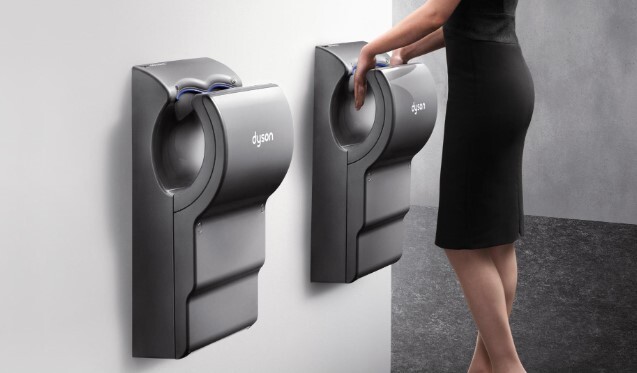
That return is significant because the hands-in format has always occupied a unique place in the commercial hand dryer market. It isn't simply another way to position an air outlet. The design changes how users interact with the dryer, how water is managed, how the fixture looks in the restroom, and how memorable the drying experience can be.
Today, hands-in dryers remain available from multiple manufacturers, and Dyson's return to the category shows that the format still has a place alongside compact hands-under dryers and integrated sink systems.
Table of Contents
Jump directly to the history, current models, or buying considerations.
| How Hands-In Dryers Work | Dyson Airblade History |
| The AB14 Returns | Mitsubishi Jet Towel |
| Hands-In Models Today | Pros & Considerations |
| Who Should Choose One? | Final Thoughts |
How Hands-In Hand Dryers Work
Traditional hand dryers typically direct air downward onto hands positioned beneath the unit. Hands-in dryers take a different approach. Users lower their hands into a vertical drying chamber where high-speed air is directed across both sides of the hands.
Depending on the model, water may be directed downward into a collection area, reservoir, drain system, or contained drying zone rather than being blown outward toward the surrounding wall and floor.
The major advantages of the format can include:
| Feature | Why It Matters |
|---|---|
| Dual-Sided Drying | Air reaches both sides of the hands during the drying cycle. |
| High-Speed Airflow | Modern hands-in dryers are designed to remove water rapidly rather than relying primarily on prolonged heat. |
| Water Control | The drying chamber can help control where water goes during use. |
| HEPA Filtration | Many premium models filter incoming air before it reaches the hands. |
| User Experience | The enclosed design creates a different and often more memorable interaction than a conventional wall-mounted dryer. |
Dyson's Impact on the Hands-In Hand Dryer
The hands-in format became globally recognizable after Dyson entered the commercial hand dryer market with its original Airblade design.
The early Airblade models introduced many restroom users to an entirely different drying experience. Instead of standing under warm air, users passed their hands through narrow sheets of high-speed air designed to remove water quickly.
The design created immediate visual recognition. Even today, many people picture the classic U-shaped hands-in dryer when they hear the term Dyson Airblade.
The AB01 was followed by later generations including the AB03, AB04 and eventually the Airblade dB AB14. As the platform evolved, Dyson refined its digital motor, filtration, drying performance and acoustics.
The influence reached well beyond Dyson. Other manufacturers introduced their own vertical hands-in designs, and the broader commercial hand dryer industry increasingly competed around high-speed drying, filtration, energy use, sound, water management and user experience.
For a deeper look at how the current Dyson lineup differs, read our new Dyson Airblade Models Compared: What's the Difference? guide.
The Dyson AB14 Has Returned to the Market
For a time, the AB14 disappeared from the current U.S. Airblade lineup while Dyson focused heavily on compact hands-under models such as the Airblade V and Airblade 9kJ, along with its Wash+Dry platform.
That made it easy to assume Dyson had permanently moved away from the hands-in format.
It hadn't.
The Dyson Airblade dB AB14 has returned to the market, restoring the iconic hands-in design to the current Dyson offering.
Its return makes sense when you consider how strongly the design is associated with the Airblade name. For many users, the AB14 isn't simply another hand dryer. It is the Airblade experience they remember.
You can compare the AB14 with HU02, HU03 and Wash+Dry on our Dyson Airblade hand dryer page.
The Mitsubishi Jet Towel's Role in the Hands-In Market
Dyson wasn't the only major manufacturer to build recognition around the hands-in format.
The Mitsubishi Jet Towel became another important design in the category. Mitsubishi had introduced Jet Towel technology in Japan years before the Airblade became globally familiar, and the product developed a reputation for high-speed drying, durability and relatively controlled acoustics.
The Jet Towel eventually left the U.S. market, although the product family continued in other regions. Its departure reduced the number of major global brands competing directly in the U.S. hands-in segment, but it did not end demand for the format.
Notable Hands-In Hand Dryers Available Today
The category now includes both the returned Dyson AB14 and hands-in alternatives from other commercial hand dryer manufacturers. Each approaches the format a little differently.
Dyson Airblade dB AB14
The AB14 is the most recognizable hands-in dryer in the current U.S. market. It combines Dyson's Airblade drying technology, HEPA filtration and iconic vertical drying chamber in a design that creates a distinctly premium user experience.
World Dryer VMAX V2
The World Dryer VMAX V2 uses a vertical hands-in design with high-speed airflow, HEPA filtration and a water collection system. It remains one of the better-known alternatives for facilities specifically seeking a hands-in drying chamber.
Saniflow Dualflow Plus
The Saniflow Dualflow Plus combines fast vertical drying with filtration, adjustable operating characteristics and a design built specifically around water control. It is one of the strongest alternatives to consider when the hands-in format itself is a priority.
ASI Triumph
The ASI Triumph is not a traditional deep hands-in dryer in exactly the same sense as the AB14, but its semi-enclosed vertical design provides a similar guided drying experience while maintaining a compact commercial profile.
Bradley AERIX+
Bradley's AERIX+ uses a modern vertical drying approach designed around fast, touchless operation. It gives facilities another option when the goal is a more guided hands-in or semi-enclosed user experience.
Palmer Fixture iStorm2
The Palmer Fixture iStorm2 is another dedicated hands-in design, combining high-speed drying with filtration, antimicrobial features and a water-management system for commercial environments.
Advantages and Considerations of Hands-In Hand Dryers
Hands-in dryers can be excellent products, but the design should be selected intentionally rather than simply because it looks impressive.
| Potential Advantage | What to Consider |
|---|---|
| Distinctive premium experience | Not every facility needs the dryer itself to be part of the design statement. |
| Water is managed within the drying area | Internal drying chambers and collection areas require regular cleaning. |
| Fast two-sided drying | Some users move more naturally through familiar hands-under dryers in extremely high-traffic environments. |
| Highly recognizable design | Hands-in units generally occupy more physical space than ultra-slim surface-mounted models. |
| Premium filtration available | HEPA filtration is now also widely available in hands-under dryers. |
Who Should Choose a Hands-In Hand Dryer?
We think hands-in dryers make the most sense when the drying experience itself is part of the facility's goals.
Premium offices, hospitality spaces, restaurants, entertainment venues, casinos and design-forward commercial restrooms may appreciate the visual impact and distinctive interaction of a hands-in design.
For facilities focused almost entirely on rapid throughput, compact wall projection or simplifying large-scale installation, a conventional high-speed hands-under dryer may be the more functional solution.
Final Thoughts: Is the Hands-In Design Still Relevant?
Absolutely.
The market has evolved, but hands-in hand dryers have never stopped offering something different. Their combination of two-sided drying, water management and distinctive user interaction continues to make the format relevant.
And the return of the Dyson AB14 is especially telling. The model most closely associated with the hands-in Airblade experience is once again available alongside Dyson's HU02, HU03 and Wash+Dry platforms.
That doesn't mean every restroom should use a hands-in dryer. It means the format remains a legitimate design choice rather than a leftover from an earlier generation of hand dryer technology.
If you're specifically considering Dyson, visit our Dyson Airblade page or read our detailed Dyson Airblade model comparison to understand exactly where the AB14 fits against the rest of the lineup.
Anthony DiCicco is the CEO of ProDryers and has worked in the commercial hand dryer industry since 2003. He contributes educational content focused on hand dryer technology, product comparisons, accessibility considerations and real-world commercial restroom applications. Meet Anthony and the ProDryers team.