
How to Read a Commercial Hand Dryer Spec Sheet
Posted by Tahnee Talley on Oct 21st 2026
How to Read a Commercial Hand Dryer Spec Sheet: What the Numbers Really Mean
The biggest number on a hand dryer spec sheet is not always the most useful number. Learn what to compare, which footnotes matter and what to confirm before ordering.
Drying time, wattage, air speed, sound level and dimensions can help narrow your choices. But they can also lead to the wrong purchase when manufacturers use different test methods, operating settings or measurement conventions.
Reviewed October 2026 | ProDryers technical buying guide
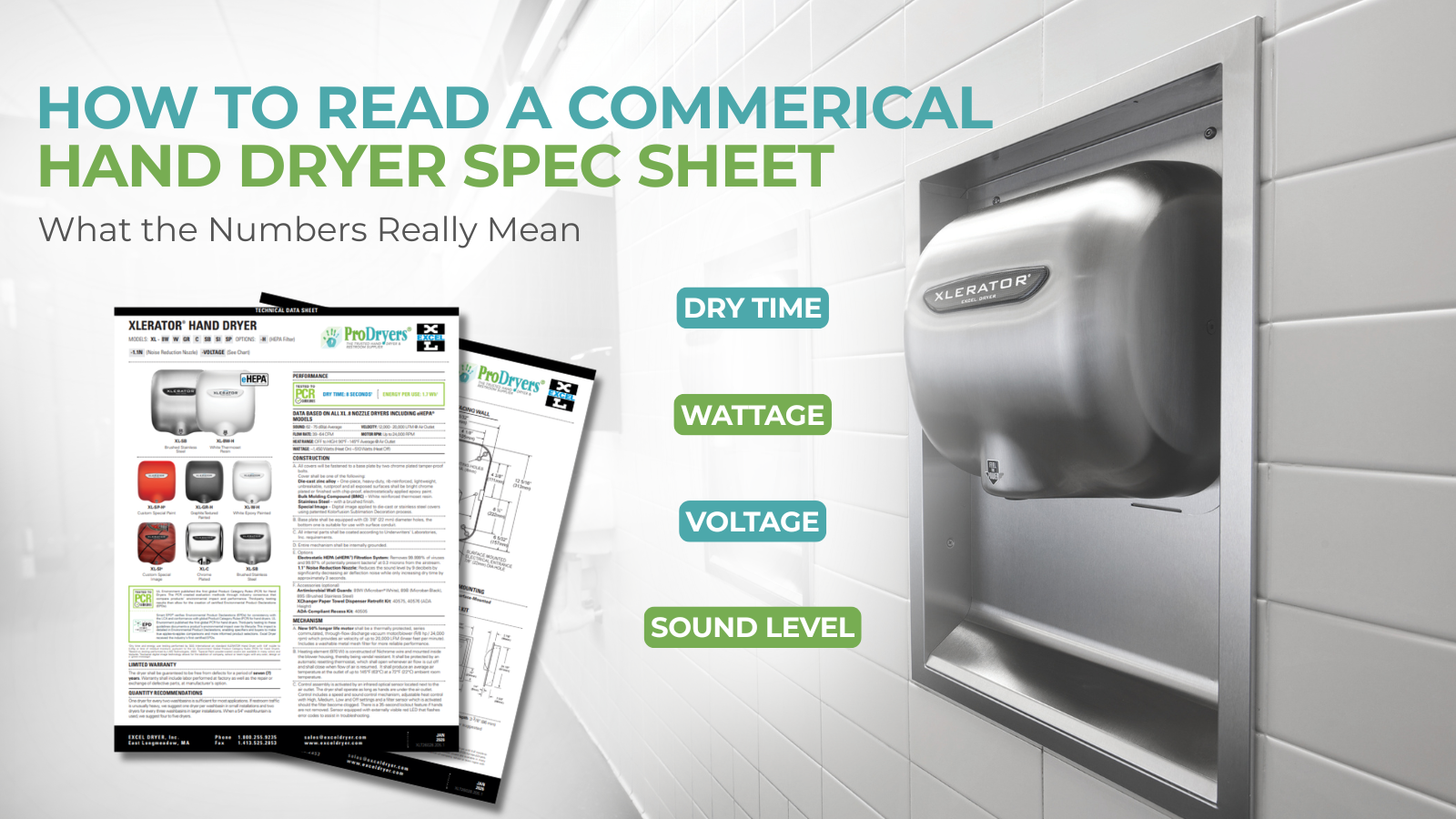
Start with the exact model and electrical configuration, then read the footnotes behind its drying time, energy use and sound rating. Confirm depth and mounting from the installation drawing, and check the written warranty separately. Don't compare two dryers as if their headline figures were measured under identical conditions.
In This Guide
Jump to the measurement or buying question you need to answer.
Start With Three Documents, Not Just the Product Page
For a commercial hand dryer, the sales page is an introduction, not a complete installation plan. Before specifying or replacing a unit, gather these three documents:
- Technical data sheet: Published performance, dimensions, power, available voltages, materials and options.
- Installation manual: Mounting dimensions, electrical connection details, clearances, service access and manufacturer instructions.
- Written warranty: Coverage, exclusions, labor, service and owner responsibilities.
Our hand dryer specifications and technical documents center collects current comparison information and manufacturer sheets for leading models. Use it to locate documents, then verify the exact configuration you intend to buy.
A Real Example: What an XLERATOR Spec Sheet Actually Tells You
The Excel Dryer XLERATOR is a useful example because its manufacturer provides more than just a large drying-time claim. The current technical documentation identifies an 8-second published dry time and 1.7 watt-hours of energy per use for the tested standard configuration.
| Published item | What a buyer should learn from it |
|---|---|
| 8-second dry time | Read the footnote: it describes a particular testing method and dryer configuration, not every possible field condition. |
| 1.7 Wh per use | Energy is measured across a cycle; it is different from the dryer's instantaneous wattage. |
| Adjustable heat and speed | Changing settings can change power, sound and drying experience. Do not assume all quoted values apply simultaneously. |
| Voltage-specific ratings | The electrician needs ratings for the exact voltage version and installation, not an average across models. |
Excel's technical sheet says the drying-time and energy testing was performed by SGS International using a standard XLERATOR with a 0.8-inch nozzle, to 0.25 gram or less of residual moisture, following hand dryer Product Category Rules. That is useful context. It tells you what the published result represents, so you can ask whether another manufacturer's number was established on a comparable basis.
What this does not prove: That every user will finish in eight seconds, or that a unit with a different nozzle, settings or installation will produce the identical result. It also does not make unrelated competitors' drying-time claims directly comparable.
Source: Excel Dryer, XLERATOR Technical Data Sheet, revision marked May 2026. Manufacturer specifications may change.
Wattage Is Not the Same as Energy Per Dry
Watts measure the rate of power use. Watt-hours measure the energy used over time. A low-wattage dryer is not necessarily more efficient per completed hand-drying cycle if it needs to run longer.
For illustration, a 1,000-watt dryer running for 10 seconds uses about 2.8 Wh. An 800-watt dryer running for 15 seconds uses about 3.3 Wh. Those are mathematical examples, not claims about particular products. Actual cycle length depends on how people use the dryer, and adjustable heat and motor settings may affect real power draw.
Also look for whether the listed wattage reflects heat on, heat off, maximum speed or an eco mode. If a seller compares energy consumption at one setting with drying time at a different setting, that comparison is not useful.
Voltage and Amperage: The Numbers You Cannot Afford to Guess
Commercial dryers may be offered in different voltage versions, and some models accept a specified voltage range. That does not make every visually similar dryer electrically interchangeable. A new cover may look like the old cover while the electrical requirements differ.
Before ordering a replacement, record the existing unit's model and electrical nameplate information, then have a qualified electrician confirm the available supply and installation requirements. Confirm:
- Voltage and frequency for the exact SKU
- Rated amperage at that voltage
- Required branch circuit and overcurrent protection, according to the current installation instructions and applicable code
- Hardwired versus permitted plug-in installation
- Where the electrical connection enters the new dryer
A facilities team sees that a newer dryer has roughly the same footprint as its existing unit and orders it by finish. Only after delivery does the installer discover that the ordered voltage configuration does not match the circuit. The avoidable mistake happened at product selection, not during installation. This is an illustrative scenario, not a reported customer case.
Air Speed, Airflow and Sound: Three Figures Often Misread
Air Speed Is Not Airflow
Air speed describes how fast air is moving at a measured point, often in MPH or linear feet per minute. Airflow describes the volume of air moved, often in cubic feet per minute (CFM). A narrow nozzle can produce a high outlet velocity without moving the same volume as a broader air delivery system.
Neither number independently describes how well air reaches wet hands. Nozzle shape, position, distance, hand movement and the overall design matter. A buyer should not compare a competitor's MPH figure with another dryer's CFM and declare a winner.
What Does a dB(A) Rating Really Mean?
Decibels are meaningful only with the measurement context. Two published ratings may not be directly comparable if one reflects sound pressure measured at a specified distance and another describes sound power, or if one dryer was tested at its lower speed setting.
Look for the measurement type, test distance, motor setting and procedure. Then consider the restroom itself: reflective tile, room dimensions and several dryers running together can substantially affect how noisy the space feels. A school restroom next to a classroom may call for a different noise tradeoff than a busy arena concourse.
If the sound figures were not measured under comparable conditions, do not use a small dB difference as the deciding factor. Ask about speed adjustment and consider the actual room and users.
Dimensions and ADA: Read the Installation Drawing, Not Just the Cover Size
Height and width tell you whether a dryer may fit the available wall area. Depth tells you how far it projects into a circulation path. That distinction becomes important when accessibility requirements apply.
Review projection, mounting height, clear floor space, approach and mounting method for the particular location. Under applicable accessibility rules, a wall-mounted object protruding into a circulation path can present an issue even if the product itself is marketed as ADA-compatible. A recess kit may help, but it also changes wall preparation and installation requirements.
Important: A product's accessibility marketing claim is not approval of every installation. The architect, contractor or other responsible professional should verify placement against applicable federal, state and local requirements.
Heat Is More Than a Yes/No Label
An unheated dryer may still deliver air that feels warm because the motor generates heat and the incoming room air has its own temperature. A model with a dedicated heating element may offer more comfort in a cooler restroom, but the heating element can increase electrical draw. If the sheet lists outlet temperature, check the measurement location and conditions before comparing it with a different model.
Look Beyond Motor RPM, Filter Labels and Warranty Years
Motor and Serviceability
Higher motor RPM does not automatically mean a dryer is faster, more durable or better suited for a busy facility. Ask about the motor design, expected service demands, replacement parts and access for maintenance. Brushed motors have wear components that may eventually need service; brushless motors eliminate brushes but still have sensors, electronics and other components.
HEPA, Antimicrobial and UV Claims
These are different features, not interchangeable cleanliness ratings. HEPA filtration concerns particles passing through a filter. Antimicrobial materials typically describe treatment of specified surfaces or components. UV technologies require details about what is treated and under what conditions. None of those labels should be interpreted as proof that the dryer disinfects users' hands or an entire restroom.
Check whether filtration is standard or optional, what replacement filters cost and how frequently the manufacturer recommends maintenance. For specialty features, read the exact claim and supporting documentation rather than assuming more technology always means better drying.
Warranty: Years Alone Are Not the Whole Promise
The duration on the sales sheet does not reveal whether labor, shipping, filters, motor brushes or on-site service are covered. Also confirm when the warranty starts and which installation or maintenance conditions apply. For the broader comparison, see our hand dryer warranties guide, then read the manufacturer's current written warranty for your exact model.
A dryer that looks best on paper can still be the wrong choice if it needs electrical changes, projects into a walkway, is too loud for the setting or requires maintenance the facility cannot reasonably support. The best specification is the one that fits the building and the people using it.
Before You Order: A Practical Spec-Sheet Checklist
When comparing two commercial dryers, work through these questions in order. They reflect the issues we recommend checking in a commercial purchasing decision, not a claim that every item appears on every manufacturer data sheet.
- Exact model: Have you identified the full SKU and available options?
- Electrical match: Has a qualified person confirmed voltage, amperage and installation requirements?
- Dry time: Is a test method or residual moisture threshold published?
- Operating mode: Which speed, heat and accessory settings produced the figures?
- Energy: Are you comparing watt-hours per cycle, not watts alone?
- Sound: Do the measurement type, distance and setting match?
- Physical fit: Are projection, mounting height, access and wall conditions acceptable?
- Maintenance: Can the facility obtain and replace any filters or service parts?
- Warranty: Have you reviewed the actual written terms?
- Real-world suitability: Does the dryer fit the facility's traffic, user needs and budget?
The Bottom Line
Read manufacturer specifications as a connected system. Drying time depends on its test conditions and configuration. Energy use depends on power and duration. Air speed is different from air volume. Sound depends on how and where it was measured. Dimensions mean little without mounting context. Warranty length means little without the written terms.
Taking a few more minutes with the spec sheet, installation instructions and warranty can prevent an incorrect order or an unexpected installation problem. And when the numbers are not comparable, the right move is to ask for the missing context rather than guess.
Comparing Two Hand Dryer Spec Sheets?
ProDryers has specialized in commercial hand dryers since 2003. We can help you interpret manufacturer documentation, identify available configurations and compare models based on your project rather than one headline number.
Call 888-503-7937 or start with the technical document library.
About ProDryers
ProDryers is part of Category Five Technologies, founded in 2003. Our team helps businesses, facility professionals and contractors compare commercial hand dryers, electrical configurations and installation requirements. This article was prepared as an educational purchasing guide using manufacturer documentation, not as a laboratory test or an independent performance certification. Meet the ProDryers team.