
Hand Dryers and ADA Standards: Are You in Compliance?
Posted by Anthony DiCicco on Feb 20th 2020
Updated September 2026
The original version of this article was supplied by Excel Dryer and focused primarily on using Excel products for ADA-conscious installations. The subject is still useful, but today's market offers more installation choices than it did when that article was written.
This guide focuses on the practical question we hear from facility managers, contractors and buyers: how should the dryer actually be installed?
If you are looking for a broader explanation of the difference between wheelchair accessibility and ADA compliance, see our Handicap Accessibility and ADA Compliance with Hand Dryers guide. If you are ready to compare products, browse our ADA hand dryer selection.
Installation & Retrofit Guide
Jump to the installation situation that matches your project.
| Wall Projection | Surface-Mounted Dryers |
| Recessing a Dryer | XLERATOR Retrofits |
| Replacing an Old Dryer | Replacing Paper Towels |
| Which Option Fits? | Quick Answers |
Start With Wall Projection
The installation question most often associated with hand dryers and the ADA is how far an object projects into a circulation path.
Section 307.2 of the 2010 ADA Standards states that objects with leading edges more than 27 inches and not more than 80 inches above the finished floor or ground may protrude a maximum of 4 inches horizontally into the circulation path.
The rule exists because wall-mounted objects above the cane-detectable range can present a hazard for people who are blind or have low vision.
For a deeper discussion of accessibility terminology and other considerations, use our separate accessibility and ADA compliance guide. Here, we are going to stay focused on installation choices.
Option 1: Use a Shallow Surface-Mounted Hand Dryer
For many projects, this is the easiest solution. Modern hand dryers are available with cabinets designed specifically to limit wall projection without cutting into the wall.
| Model | Why It Works Well | Our Take |
|---|---|---|
| Dyson Airblade V HU02 | 4-inch-deep cabinet, high-speed drying and HEPA-filtered air | Excellent premium choice for busy restrooms |
| World Dryer VERDEdri | 3.9-inch depth, HEPA filtration and adjustable performance | One of our favorite traditional hands-under ADA options |
| Excel Dryer ThinAir | Shallow Excel Dryer design intended for surface-mounted ADA applications | Good fit when you want Excel without recessing an XLERATOR |
Dyson Airblade V HU02
The Dyson Airblade V HU02 is our primary Dyson recommendation for many high-traffic projects. Its cabinet is 4 inches deep, so it gives designers a compact surface-mounted format without moving to a recessed installation.
World Dryer VERDEdri
The World Dryer VERDEdri is another strong solution. World Dryer specifies the unit at 3.9 inches deep and identifies it as an ADA-compliant surface-mounted dryer. It also includes HEPA filtration and adjustable performance.
Excel Dryer ThinAir
The Excel Dryer ThinAir remains relevant from the original Excel Dryer article. It was designed as a shallow-profile surface-mounted alternative for projects where protrusion is a concern.
Option 2: Recess a Deeper Hand Dryer
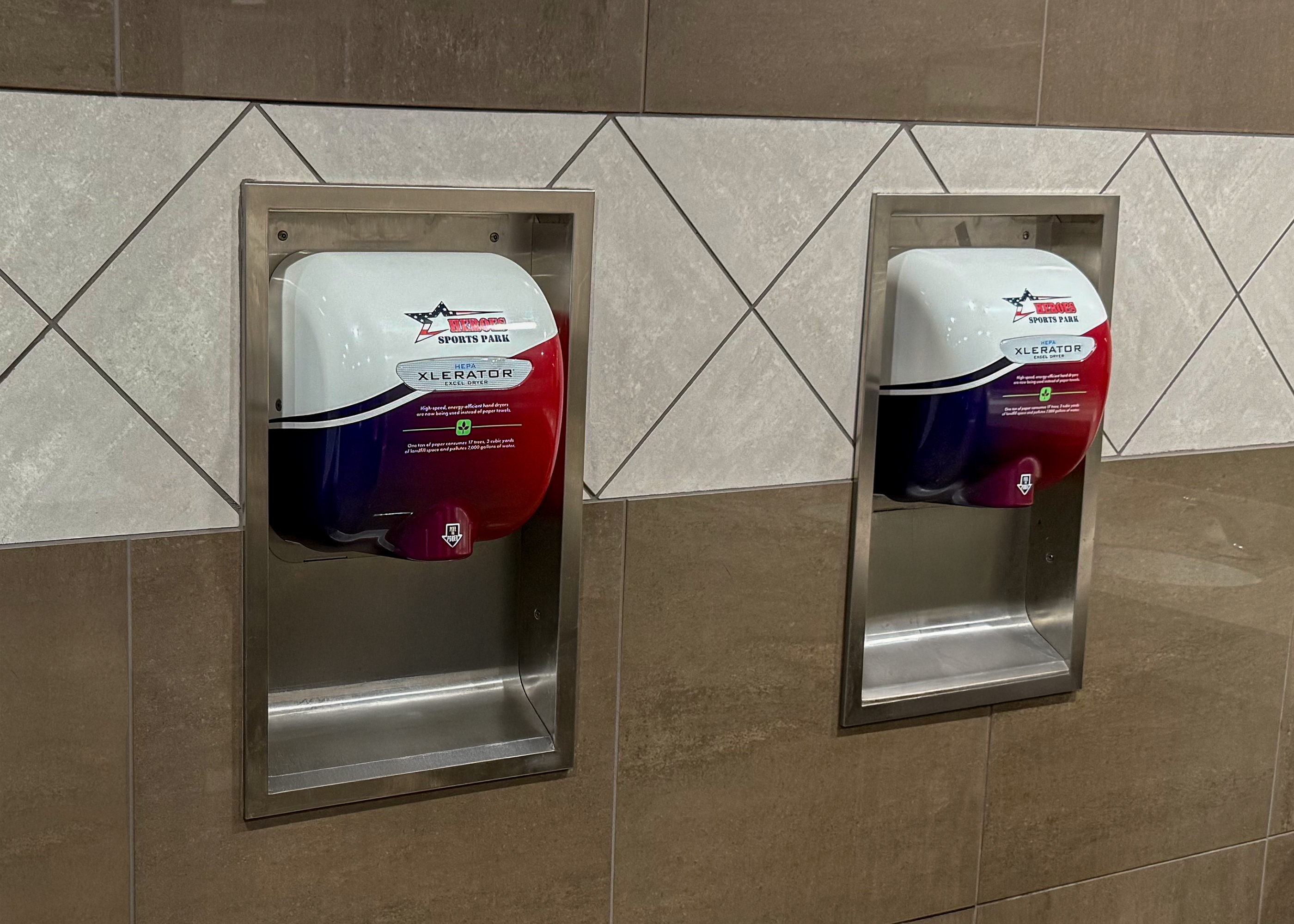
A dryer does not have to be shallow by design if the installation allows part of the cabinet to sit inside the wall.
Recess kits are useful when a facility prefers a particular dryer but needs to reduce how far the finished installation projects beyond the wall surface.
Advantages of recessing
You can retain a dryer with a deeper cabinet while reducing its exposed wall projection.
Tradeoff
The installation is more involved. Wall construction, cavity depth, framing, electrical placement and the dimensions of the recess kit all need to be considered.
Installing an XLERATOR When Wall Projection Matters
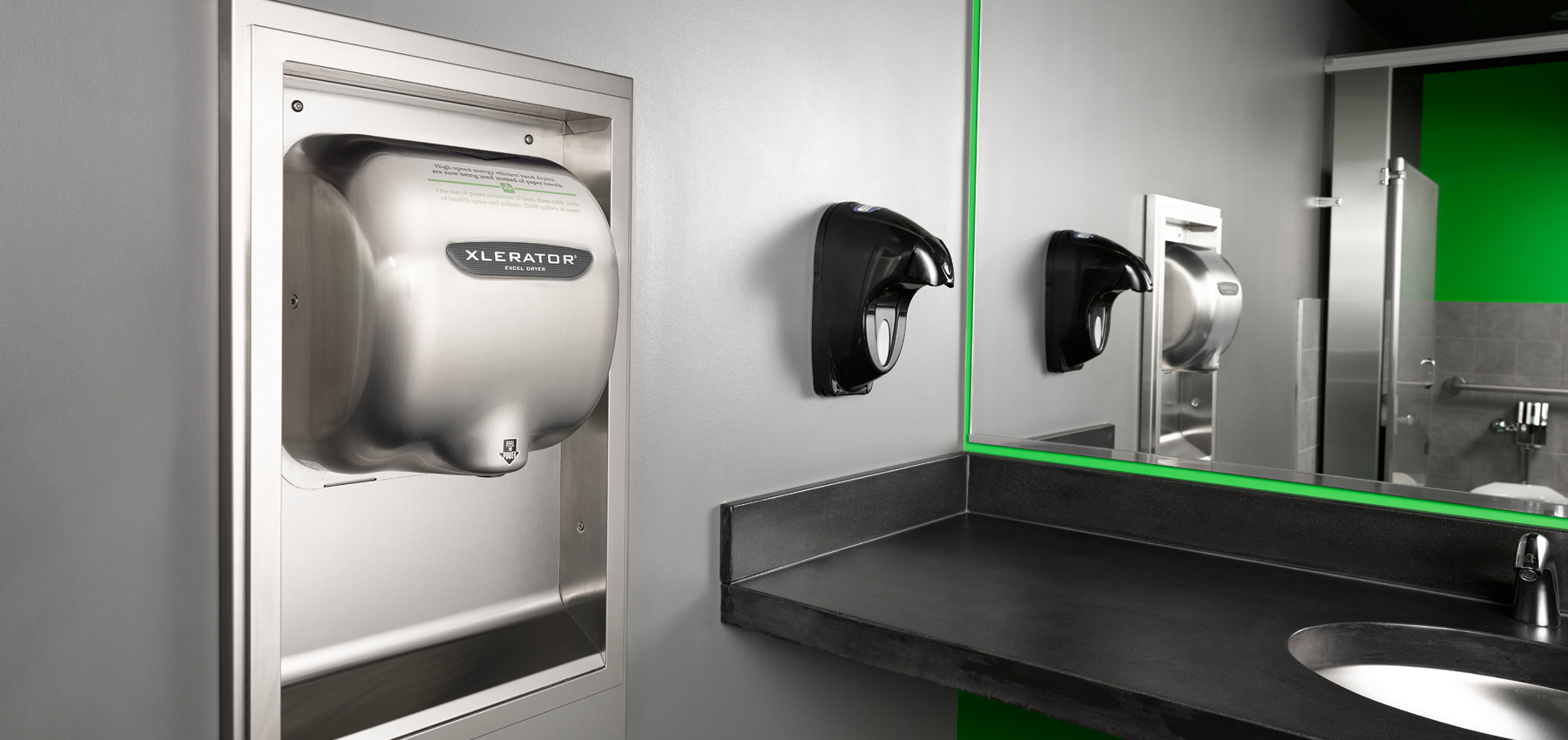
The Excel Dryer XLERATOR is the clearest example of when a recess kit can make sense.
A standard surface-mounted XLERATOR projects farther from the wall than a ThinAir, HU02 or VERDEdri. That does not mean the XLERATOR is automatically off the table. Excel offers recessing solutions that allow much of the dryer body to sit inside the wall.
This is a good example of why we prefer to start with the project instead of simply labeling one dryer "ADA" and another "not ADA." Installation method can completely change the equation.
Replacing an Existing Hand Dryer
Replacement projects can be easier than new installations in some ways, but the old mounting location should not automatically dictate the new one.
Older commercial dryers were often much deeper than today's shallow-profile models. That gives facilities an opportunity to improve the installation when the old dryer is removed.
Before ordering the replacement, check:
- The depth and wall projection of the new dryer
- Whether the dryer sits along a circulation path
- The existing mounting height and location
- Available clear floor space
- Existing electrical service and circuit requirements
- Whether the old mounting holes will be covered
- Whether a surface-mounted or recessed replacement makes more sense
Do not assume that a recess kit is automatically necessary just because the old dryer was recessed. A modern shallow unit may allow you to simplify the new installation.
Replacing a Paper Towel Dispenser With a Hand Dryer
Converting from paper towels creates a different challenge. The old dispenser or dispenser/waste-receptacle combination may leave a large opening, wall damage or a mounting footprint that a conventional dryer will not cover.
Excel developed its XChanger retrofit systems specifically for projects like these. The system can help transition an existing towel-dispenser location to an XLERATOR installation while covering the previous opening.
Before ordering any retrofit system, verify the dimensions and configuration of the existing dispenser, wall opening and surrounding surfaces. Retrofit kits are not universal covers for every previous installation.
Which Installation Option Makes the Most Sense?
| Project Situation | Start Here | Why |
|---|---|---|
| Avoid cutting into the wall | Shallow surface-mounted dryer | Usually the simplest installation |
| Premium high-traffic surface mount | Dyson HU02 | Compact 4-inch depth with HEPA-filtered air |
| Traditional hands-under surface mount | World Dryer VERDEdri | 3.9-inch depth, HEPA filtration and adjustable performance |
| Want Excel without recessing | Excel ThinAir | Purpose-built shallow Excel Dryer option |
| Want an XLERATOR specifically | XLERATOR + appropriate recess solution | Reduces exposed projection while retaining XLERATOR |
| Replacing recessed paper towels | Evaluate retrofit/XChanger options | May help cover the existing opening |
For a larger selection of shallow and ADA-oriented models, browse our ADA compliant hand dryers.
Quick Answers About ADA Hand Dryer Installation
Do ADA hand dryers have to be recessed?
No. Several commercial dryers are designed with shallow cabinets specifically for surface mounting where wall projection is a concern. Examples include the Dyson Airblade V HU02, World Dryer VERDEdri and Excel Dryer ThinAir.
Can an XLERATOR be recessed?
Yes. Excel Dryer offers recessing solutions for XLERATOR installations. Recessing can reduce the amount of the dryer cabinet that extends beyond the finished wall.
Is a 4-inch-deep hand dryer automatically ADA compliant?
No. The four-inch limit applies to certain objects protruding into circulation paths, and accessibility involves more than product depth. The location, mounting and surrounding space must also be considered.
Should I reuse the mounting location of my old dryer?
Not automatically. Check the new dryer's projection, mounting recommendations, electrical requirements and available clear space before using the existing location. A newer shallow dryer may work better in a slightly different position.
Where can I learn more about ADA compliance versus wheelchair accessibility?
See our Handicap Accessibility and ADA Compliance with Hand Dryers article for a broader explanation of accessibility terminology and planning considerations.
Planning a Hand Dryer Retrofit?
Tell us what dryer or paper towel dispenser is there now, whether the wall can be opened and what kind of facility you are working with. We can help determine whether a shallow surface-mounted dryer, recess kit or retrofit system makes the most sense.
Shop ADA Hand Dryers Use Our Hand Dryer SelectorAbout this guide: This article was substantially updated in September 2026. The original version was supplied by Excel Dryer and focused primarily on Excel products. The current ProDryers guide focuses on practical hand dryer installation and retrofit decisions, including surface mounting, recessing, replacement projects and paper towel conversions. Accessibility and building-code requirements can vary by facility, installation and jurisdiction. Always review current ADA Standards, applicable local requirements, manufacturer installation documentation and project-specific requirements before specifying equipment.
Anthony DiCicco is the founder and CEO of Category Five Technologies and ProDryers. Since 2003, he has worked in the commercial hand dryer industry, helping businesses, architects, contractors and facility professionals compare and specify hand drying solutions. His recommendations are based on more than two decades of firsthand product, customer and commercial restroom experience. Meet Anthony and the ProDryers team.