
XLERATOR vs. XLERATOReco: The Expert Buyer’s Guide.
Posted by ProDryers on Sep 5th 2025
Excel Dryer Heated XLERATOR vs. No-Heat XLERATOReco: ProDryers Guide
At ProDryers, we make Excel Dryer choices obvious at a glance. Our custom product images use simple eco and hepa tags so shoppers can instantly see Eco versus heated and whether HEPA filtration is included. Because Excel’s options create many valid combinations, we list every unique SKU by cover, voltage, Eco vs. heated, and HEPA so you know exactly what you’re buying. See how easy we make buying on our XLERATOR hand dryer page.
We’ve been selling hand dryers for more than two decades. When the XLERATOReco by Excel Dryer launched, it quickly became our unit-volume leader, largely because of price and electrical install economics. In conversations with facilities teams, the heated XLERATOR remains a favorite for user comfort, but Eco wins on large rollouts where amperage and energy budgets matter.
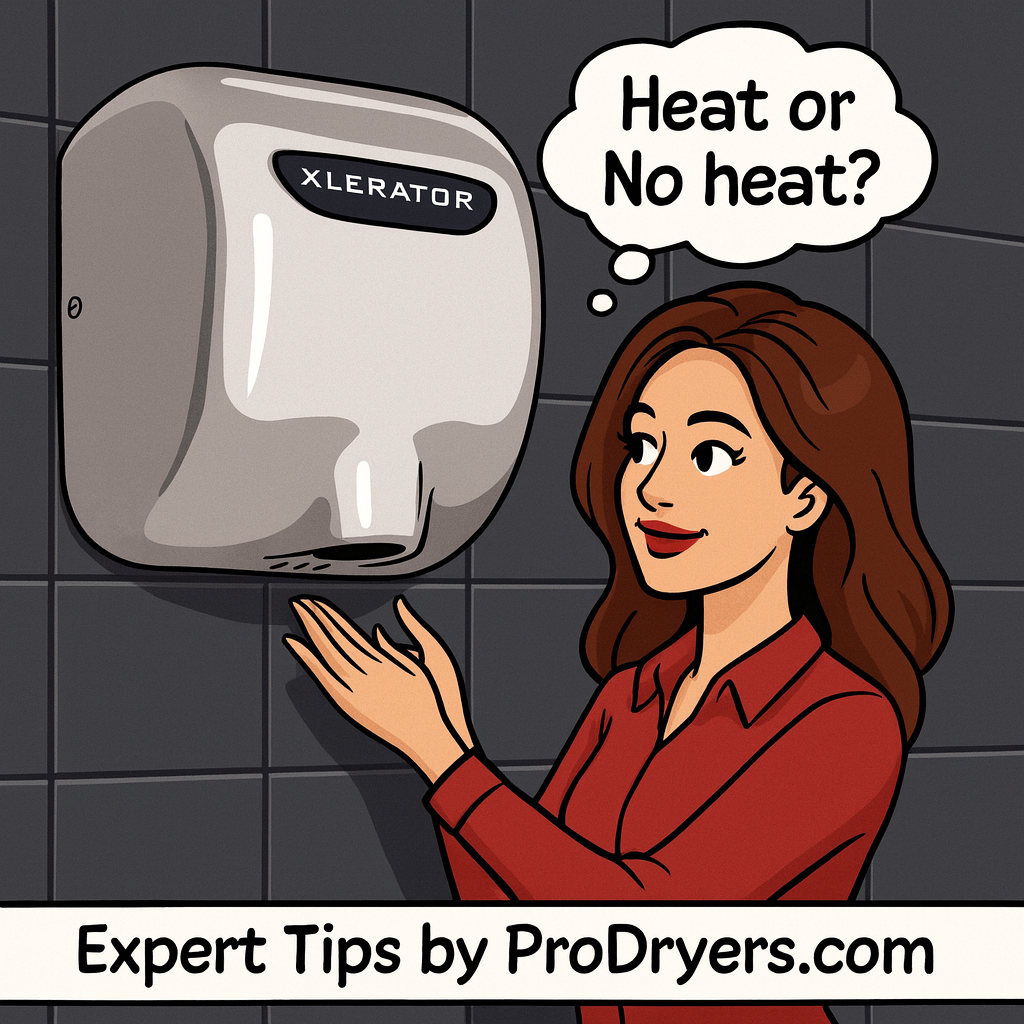
The two core platforms
Excel Dryer XLERATOR (heated platform)
High-speed dryer with adjustable heat control. Settings include High, Medium, Low, and Off. At 110–120 V, typical draw is roughly 1,450 watts with heat on and about 510 watts with heat off. Current is about 11–12 amps with heat on and about 4.3–4.5 amps with heat off. Published dry time is about 8 seconds using the standard 0.8 inch nozzle under the industry test method.
Excel Dryer XLERATOReco (no-heat platform)
No heating element by design. At 110–120 V, typical draw is about 425–530 watts, roughly 4.3–4.5 amps. Published dry time is about 10 seconds with the standard nozzle under the same test method.
ProDryers tip on nozzles and noise
To keep buying simple and reduce noise across the board, we standardize both XLERATOR and XLERATOReco with the factory 1.1 inch nozzle already installed. In real-world use, customers don’t perceive a meaningful difference in dry time, and we’ve had zero complaints on noise or speed in more than two decades.
Circuit planning that changes project cost
- Heated XLERATOR with heat on draws roughly 11–12 A at 120 V, so many projects plan one unit per 20 A circuit.
- XLERATOReco draws about 4.3–4.5 A at 120 V. On many projects, two or three Eco units can share a single 20 A circuit, which lowers electrical labor and saves panel space.
- You can operate heated XLERATOR with heat off to reduce amperage; most facilities keep heat on for comfort. Always coordinate final circuit counts and labeling with your electrician and local code.
Energy-per-dry math you can verify
Use these simple formulas so specifiers and energy teams can run the numbers for their own rates and traffic.
- Energy per dry (kWh) = Power (kW) × Dry time (seconds) ÷ 3600
- Annual energy (kWh) = Energy per dry × Uses per day × 365
- Annual cost ($) = Annual kWh × Local $/kWh
Example (assumptions: 120 V units, $0.12/kWh, 300 uses/day per dryer):
|
Model |
Nameplate power & time |
Energy per dry |
Annual kWh |
Annual $/unit |
|---|---|---|---|---|
|
XLERATOR heat ON |
~1.45 kW × 8 s |
~0.00322 kWh |
~352 |
~$42 |
|
XLERATOR heat OFF |
~0.51 kW × 8 s |
~0.00113 kWh |
~124 |
~$15 |
|
XLERATOReco (no heat) |
~0.53 kW × 10 s |
~0.00147 kWh |
~161 |
~$19 |
Swap in your own $/kWh and daily uses, then multiply the per-unit delta by your fleet size. That’s where Eco’s advantages add up for airports, stadiums, universities, and big venues.
HEPA options and how model numbers change
Both platforms can be ordered with a HEPA Filtration System. The HEPA option appears in the model string and changes the SKU, so it’s easy to tell whether a unit is HEPA-equipped. During the COVID era, HEPA interest spiked. In our sales and support data, roughly nine out of ten buyers still choose non-HEPA, mostly because dryers are already touchless and the added cost is hard to justify for many facilities. If you have a brand policy or infection-control requirement, HEPA is available on either platform.
Real-world buying patterns we see
- Large rollouts such as airports, stadiums, universities, arenas, and convention centers tend to choose XLERATOReco. Lower amperage allows multiple dryers per 20 A circuit and delivers energy savings at scale.
- Smaller installs like restaurants, boutique hotels, offices, and highway rest areas often choose the heated XLERATOR for perceived warmth, especially in cooler climates or premium spaces.
Excel Dryer XLERATOR vs. XLERATOReco at a glance
|
Feature |
XLERATOR (heated) |
XLERATOReco (no heat) |
|---|---|---|
|
Dry time (test method) |
About 8 seconds |
About 10 seconds |
|
Power at 110–120 V |
~1,450 W heat on, ~510 W heat off |
~425–530 W |
|
Current at 110–120 V |
~11–12 A heat on, ~4.3–4.5 A heat off |
~4.3–4.5 A |
|
Circuit planning |
Often one unit per 20 A circuit with heat on |
Often 2–3 units per 20 A circuit |
|
Heat |
High, Medium, Low, Off |
No heating element |
|
HEPA availability |
Optional |
Optional |
|
Typical best fit |
Smaller to mid installs prioritizing comfort |
Large rollouts prioritizing install cost and energy |
Are dry times meaningfully different?
On paper, heated shows about a two-second advantage under standardized test conditions. In practice, correct hand position and speed settings matter more. With our standardized 1.1 inch nozzle, we don’t see noise complaints or “slow” comments from users on either platform.
Total cost of ownership beyond energy
- Electrical labor and panel space: Eco’s lower amps can reduce the number of circuits, breakers, conduit runs, and copper.
- Service parts: Neither platform is maintenance heavy; filters apply only if you choose HEPA.
- Reliability: These dryers are USA-made and carry a seven-year limited warranty. Across a very large installed base sold by ProDryers, warranty calls are under one percent in our experience. Many units have been operating for well over a decade with only routine cleaning.
Seasonal and policy tips from the field
- In mild climates, facilities sometimes run heated units on Low or Off during summer, then bump heat back up in winter if occupants prefer warmth.
- If policy or branding calls for filtered intake air, add HEPA to either platform and plan routine filter service intervals. If cost control is the priority and ventilation is strong, most buyers opt for non-HEPA.
A fast decision framework
- Traffic: fewer than 6 units per restroom → consider Heated. Dense banks or 6+ units → Eco.
- Power: tight panel space, long conduit runs, or remodel constraints → Eco.
- Comfort policy: premium venues or cold-climate sites → Heated.
- Filtration policy: healthcare or brand standards → HEPA on either platform.
- Budget: lowest install and operating costs → Eco typically wins.
ProDryers perspective
We’ve sold hundreds of thousands of Excel Dryer XLERATOR-family dryers. Regardless of heat or HEPA options, warranty issues are rare relative to the installed base. Tell us your voltage, cover finish, Eco vs. heated, and HEPA preference. We’ll confirm circuit counts, match the exact SKU, and send a direct checkout link so you can buy immediately.
FAQ
Does the standard XLERATOR have a heat off setting
Yes. Heat can be set to High, Medium, Low, or Off. Many sites run heat on for comfort, but turning heat off reduces current draw.
Can multiple XLERATOReco units share one circuit
Yes. At 110–120 V, Eco’s current draw is low enough that two or three units can often share a single 20 A circuit. Always confirm final counts with your electrician and local code.
Is there a real dry-time gap between heated and Eco
Published tests show about a two-second difference. In daily use, correct hand position and speed settings matter more, and users rarely notice a difference.
Should I choose HEPA
Pick HEPA if policy or branding calls for filtered intake air. If not required, most buyers choose non-HEPA because dryers are already touchless and the extra cost isn’t necessary for their use case.
Which model is better for large projects
XLERATOReco typically wins large rollouts thanks to lower amperage, circuit sharing, and energy savings at scale.
Which model is better for small installs
Heated XLERATOR fits smaller installs that prioritize comfort and already have dedicated circuits available.