
Hand Dryer Voltage Options Explained
Posted by Tahnee Talley on Mar 4th 2026
Understanding Hand Dryer Voltage Options for Commercial Restrooms
Choosing the correct voltage is one of the most important steps when selecting a commercial hand dryer. Every building is wired with a specific electrical supply, and the hand dryer must match that supply in order to operate safely and correctly.
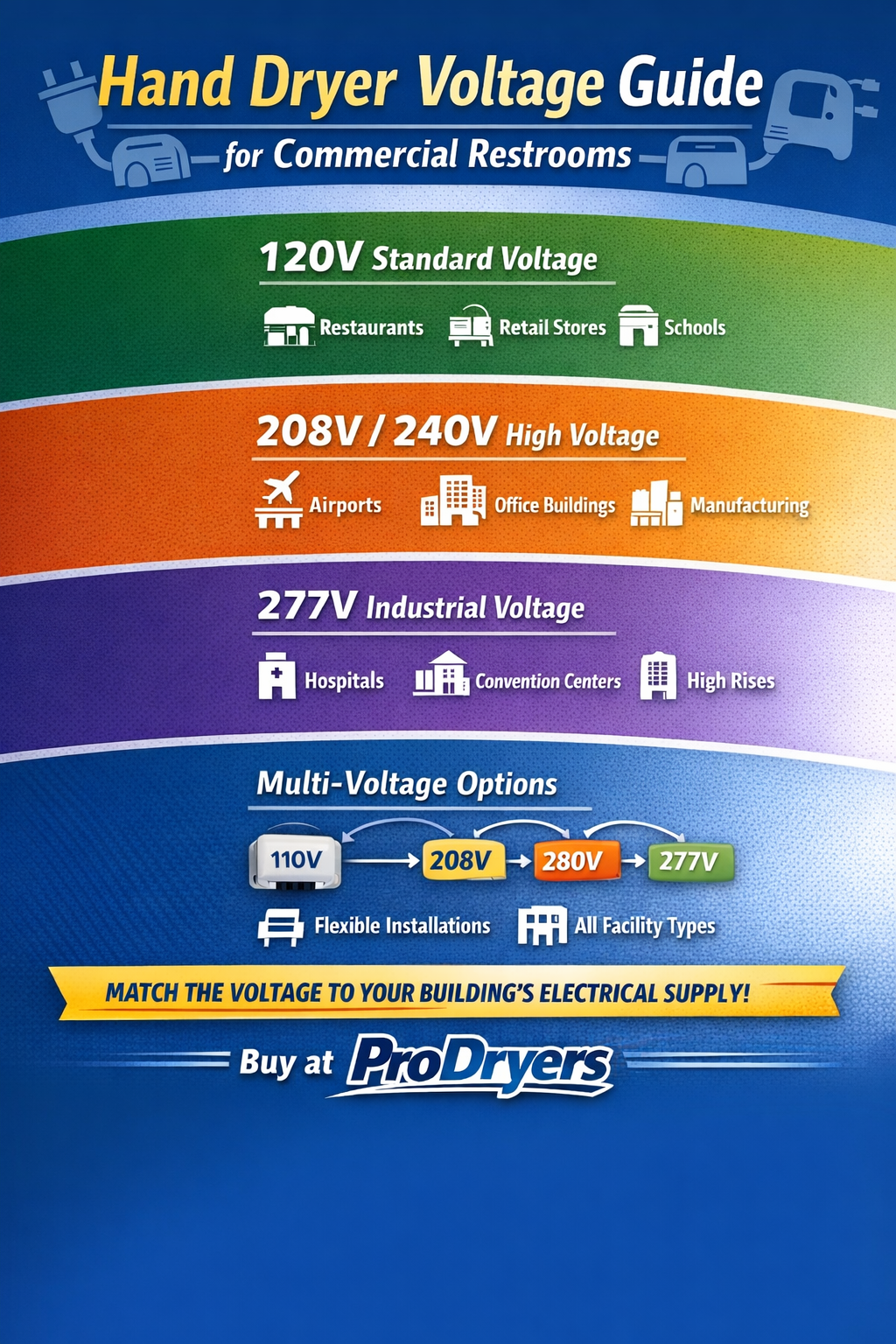
Commercial hand dryers are manufactured for the most common voltages used in North American buildings, including 110V, 115V, 120V, 208V, 220V, 240V, and 277V. Some models are also available with multi-voltage configurations, allowing the same dryer design to operate across different electrical systems.
Selecting the correct voltage ensures proper performance, prevents electrical issues, and allows the dryer to be installed without modifying the building’s wiring.
At ProDryers, we stock hand dryers designed for all common commercial voltages so facilities can select a unit that works with their electrical infrastructure.
The Most Common Hand Dryer Voltage in the United States
Most commercial restrooms in the United States are wired with 110 to 120 volt circuits. Because of this, many commercial hand dryers are manufactured in versions designed specifically for this voltage range.
Electrical supply in this range may be labeled as 110V, 115V, or 120V, but for equipment purposes these values are generally treated as the same voltage category.
Hand dryers designed for this range are commonly installed in:
• Restaurants
• Retail stores
• Small offices
• Churches
• Medical clinics
• Schools
• Older commercial buildings
Since this voltage is already present in most restrooms, installation is often straightforward.
ProDryers Tip
Many widely installed hand dryers are available in 120V versions, including models like the Excel Dryer XLERATOR, AirDri dryers such as the PowerDRI, CompactDRI, and ComfortDRI, and the Dyson Airblade LV series. These are commonly selected when replacing paper towel dispensers because most restrooms already have 120V circuits available.
208 Volt and 240 Volt Hand Dryers
Large commercial buildings often operate on three-phase electrical systems, which commonly supply 208 volt circuits. Some facilities may also use circuits in the 220 to 240 volt range depending on the building’s electrical infrastructure.
Hand dryers designed for these voltages are commonly installed in:
• Airports
• Universities
• Large office buildings
• Manufacturing facilities
• Stadiums and arenas
• Government buildings
Manufacturers often produce dryers in specific voltage versions so the unit can match the electrical supply available in the facility.
ProDryers Tip
Large commercial buildings frequently distribute 208V to 240V circuits for restroom equipment. High speed dryers like the Excel Dryer XLERATOR are available in dedicated voltage versions for these systems. AirDri models such as the PowerDRI, CompactDRI, and ComfortDRI are offered in 230V versions, which are commonly installed in facilities using higher voltage restroom circuits.
277 Volt Hand Dryers in Large Commercial Buildings
Some large facilities have restroom circuits that operate on 277 volt electrical service, which is commonly derived from a 480 volt building power system.
Hand dryers designed for 277V operation are sometimes installed in facilities such as:
• High rise office buildings
• Hospitals
• Airports
• Convention centers
• Government facilities
Using dryers designed for the available voltage allows installation without modifying existing electrical systems.
ProDryers Tip
Some high efficiency dryers such as the Excel Dryer XLERATOR and the World Dryer VERDEdri are available in 277V versions, making them suitable for buildings where this voltage is already distributed throughout the facility.
ProDryers Tip
Many large commercial buildings distribute 480V three-phase electrical service, which commonly feeds 277V lighting circuits throughout the facility. Installing 277V hand dryers allows contractors to connect the dryer directly to the available circuit without installing transformers or running new wiring.
Multi-Voltage Hand Dryers
Some hand dryers are designed with multi-voltage capability, meaning the same unit can operate across a range of electrical inputs depending on how it is wired during installation.
Multi-voltage dryers can be useful when:
• A company standardizes equipment across multiple facilities
• Buildings have different electrical systems
• Installation requirements vary between locations
ProDryers Tip
Some dryers support multiple voltage ranges, allowing them to be installed in several types of commercial electrical systems. For example, certain Excel Dryer XLERATOR multi-voltage models operate between 208V and 277V, while the World Dryer VERDEdri can automatically adjust between 120V and 277V.
Why Matching Voltage Matters
Installing a hand dryer that matches the building’s electrical supply is important for both safety and performance.
Using the wrong voltage can result in:
• Equipment damage
• Improper operation
• Electrical hazards
• Circuit breaker trips
• Manufacturer warranty issues
Confirming voltage before purchasing a dryer helps ensure the equipment operates correctly and can be installed without complications.
How to Determine the Voltage in Your Restroom
Before purchasing a hand dryer, it is important to confirm the voltage of the electrical circuit serving the restroom.
You can determine the voltage by:
• Checking the electrical panel that supplies the restroom
• Reviewing the rating plate on an existing hand dryer
• Consulting the building electrician or maintenance team
• Reviewing electrical drawings for the facility
Confirming the available voltage ensures the correct dryer is selected and helps avoid installation delays.
Hand Dryer Voltage FAQs for Facility Managers and Electricians
What voltage do most commercial hand dryers use?
Most commercial hand dryers in the United States operate on 110 to 120 volts, which is the most common electrical supply available in restroom circuits.
Are 110V, 115V, and 120V hand dryers the same?
Yes. In most commercial electrical systems, 110V, 115V, and 120V are considered part of the same voltage range.
Can a 120V hand dryer be connected to a 208V or 240V circuit?
No. A dryer designed for 120 volts must not be connected to higher voltage circuits such as 208V or 240V.
Why are some hand dryers available in multiple voltages?
Manufacturers produce dryers in different voltage versions so the unit can match the electrical supply used in different buildings.
Are higher voltage hand dryers more powerful?
Not necessarily. Drying performance depends on motor design, airflow, and heating systems, not just voltage.
Can a hand dryer be converted to a different voltage?
Most commercial hand dryers cannot be converted to a different voltage after installation because internal components are designed for specific electrical ranges.
How can I find out what voltage my restroom has?
You can determine restroom voltage by checking the electrical panel, reviewing the rating plate on the existing dryer, consulting a building electrician, or reviewing electrical plans.
Need Help Choosing the Correct Hand Dryer Voltage
If you are unsure which voltage your building uses, our team can help you determine the correct option before you purchase.
Call 888-503-7937 and a ProDryers specialist will help you choose the right hand dryer voltage for your facility.
About the Author
Tahnee Talley is the Operations Manager at ProDryers and has been with the company since 2009. She contributes educational content about commercial hand dryers, restroom accessories, and product selection for facilities, contractors, and building managers. Read more about Tahnee on our meet the team page.