
Hand Dryers for 110, 115, and 120 Volt Installations
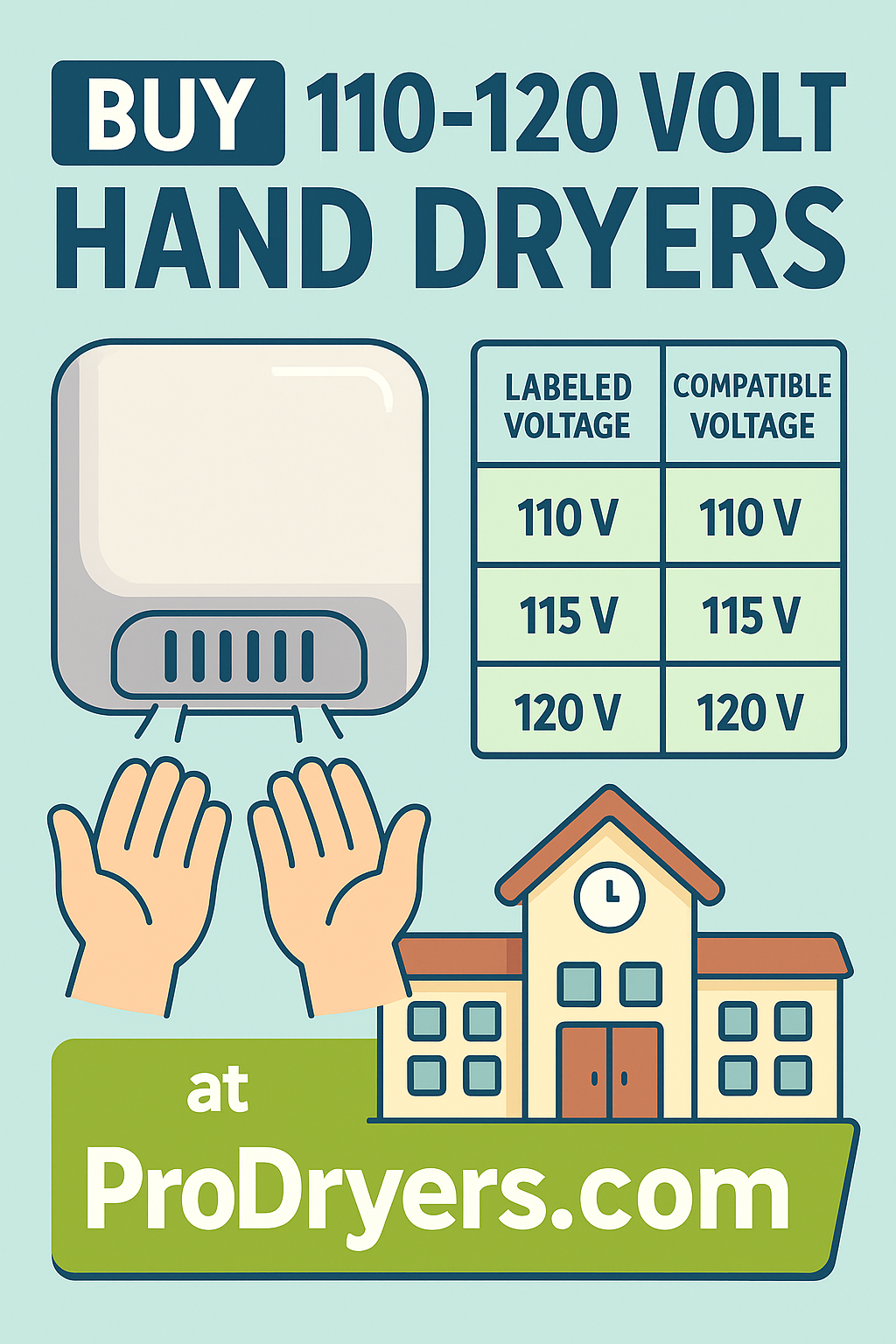
When shopping for a commercial hand dryer, one of the first technical details you’ll encounter is voltage. Many buyers search for 110 volt hand dryers, 115 volt hand dryers, or 120 volt hand dryers, but in reality, these all fall under the same standard voltage range.
This article will help you understand the differences, why manufacturers list voltages differently, and how to choose the right 110–120 volt hand dryer for your facility.
Understanding Voltage in Hand Dryers
In North America, most commercial buildings use two common voltage ranges for restroom appliances:
- 110–120 Volt Range (sometimes labeled as 110V, 115V, or 120V)
- 208–277 Volt Range
When you see a product listed as 110V, 115V, or 120V, it’s referring to the same low-voltage range. Manufacturers use different labeling, but all these units are designed to operate properly on any standard 110–120V circuit.
For example, the Excel Dryer XLERATOR comes in two main options:
- 110–120 Volt model (the most commonly purchased version)
- 208–277 Volt model (for schools, airports, and large buildings with higher voltage wiring)
Hand Dryers: 110–120V vs 208–277V
Here’s a side-by-side look at how the two voltage options compare:
| Feature | 110–120 Volt Hand Dryers | 208–277 Volt Hand Dryers |
|---|---|---|
|
Common Locations |
Small businesses, restaurants, retail, offices |
Schools, hospitals, airports, universities, large facilities |
|
Ease of Installation |
Works with standard outlets, simple install |
Requires higher voltage wiring and professional installation |
|
Performance |
Excellent for low to medium traffic restrooms |
Optimized for high-traffic restrooms and faster turnover |
|
Energy Efficiency |
Very efficient for smaller facilities |
Maximizes efficiency in large-scale buildings |
|
Longevity |
7–10 years with proper care |
7–10 years, designed for heavier daily use |
|
Risk of Mismatch |
Safe for most U.S. buildings |
Must confirm building wiring before installation |
Why 110–120 Volt Hand Dryers Are Popular
- Compatibility: Most small businesses, restaurants, offices, and retail spaces in the U.S. are wired for 110–120V outlets.
- Ease of Installation: These units can often be installed without major electrical upgrades.
- Wide Availability: Nearly every major brand offers a 110–120V option, making it easy to find replacements or upgrades.
- Cost-Effective: For facilities that don’t require high-capacity power, these units provide the best balance of performance and affordability.
When Higher Voltage Is Needed (208–277 Volt)
While 110–120V is common, many schools, universities, hospitals, airports, and industrial buildings are wired for higher voltages. These facilities often prefer 208V, 220V, 240V, or even 277V dryers because:
- They can handle higher restroom traffic with faster dry times.
- High voltage options often optimize energy efficiency in large buildings.
- Using the wrong voltage can damage the dryer and void the warranty.
⚠️ Important Note: Installing a 208–277V hand dryer on a 120V line will prevent the unit from functioning and may fry the motor or circuits. Likewise, installing a 120V dryer on a 208–277V line will immediately burn out the dryer. Always confirm your building’s electrical setup before purchasing.
Consulting with Your Electrician
Before ordering, consult with your licensed electrician or building engineer. They can verify:
- Which voltage your restroom is wired for
- Whether your circuit can handle the dryer’s amperage draw
- If multiple dryers can run on the same line
Professional installation is strongly recommended, especially for hardwired models.
Recommended 110–120 Volt Hand Dryers
At ProDryers.com, we carry a wide selection of 110–120V hand dryers from top brands. Some of the most popular models include:
- Excel Dryer XLERATOR (110–120V) – Fast 8-second dry time, available with optional HEPA filtration, backed by a 7-year warranty.
- Dyson Airblade V HU02 (110–120V) – Sleek, compact design with HEPA filtration, ADA-compliant depth.
- World Dryer SMARTdri (110–120V) – Customizable heat and speed settings with long lifespan.
- ASI Turbo-Dri (110–120V) – Budget-friendly yet durable, suitable for small businesses.
Each of these models is designed for maximum efficiency on a 110–120V line, giving businesses reliable performance without electrical complications.
Frequently Asked Questions
Are 110V, 115V, and 120V hand dryers different?
No. These labels all refer to the same operating range. Any dryer listed as 110V, 115V, or 120V will work on a standard U.S. electrical line.
Can I use a 208–277V hand dryer on a 120V line?
No. Doing so can damage the motor and void the warranty. Always match the dryer to your building’s voltage.
How do I know which voltage I need?
Check with your electrician. Small businesses usually have 110–120V wiring, while large facilities often use 208–277V.
Are 110–120V dryers less powerful than 208–277V dryers?
Not necessarily. Many 120V models perform just as well, but high-traffic locations may benefit from higher voltage models for efficiency and load distribution.
What happens if I install the wrong voltage dryer?
Installing the wrong voltage will likely burn out the unit immediately. It can also create electrical hazards and void the manufacturer’s warranty.
Conclusion: Choosing the Right Voltage Matters
Whether you search for 110 volt hand dryers, 115 volt hand dryers, or 120 volt hand dryers, you’re really looking at the same voltage category: the 110–120V range. These models are the most common choice for small to medium-sized businesses and ensure easy installation and compatibility.
If your building requires higher voltage, a 208–277V hand dryer may be the better option, but always confirm with your electrician before purchasing.
At ProDryers.com, we stock both 110–120V and 208–277V hand dryers from leading brands like Excel Dryer, Dyson, World Dryer, and more. Contact us today for expert guidance and ensure you choose the right model for your facility.