
Choosing a Sloan Faucet
Posted by ProDryers on Sep 17th 2025
How to Choose a Sloan Faucet: The Complete, Expert Guide
Choosing the right Sloan faucet can feel overwhelming if you are not sure where to start. Sloan offers several families, each with different power options, flow rates, outlet types, and service profiles. Pick well and you will avoid splash issues, reduce maintenance, and meet code with confidence.
Need help today or want a quote that saves you money on freight and parts bundles? Call 888-503-7937. Our experts will match you with the right faucet and package the parts for the best delivered price.
Key considerations before you buy
Sink depth and splash risk
Shallow sink bowls tend to splash if the spout is too tall. Choose a Low body spout for shallow lavs. Use Mid or High bodies when the sink is deeper or you need more clearance.
Traffic level
High traffic facilities usually do best with hardwired or energy harvesting power. Battery can be great for low traffic retrofits.
Water conservation and sustainability goals
If you need LEED or WaterSense alignment, target 0.35 gpm with a laminar outlet. For everyday commercial use, 0.5 gpm often balances experience and savings.
Maintenance access
If your staff cannot spend time under the deck, above deck service designs are very attractive. BASYS is a common pick for this reason.
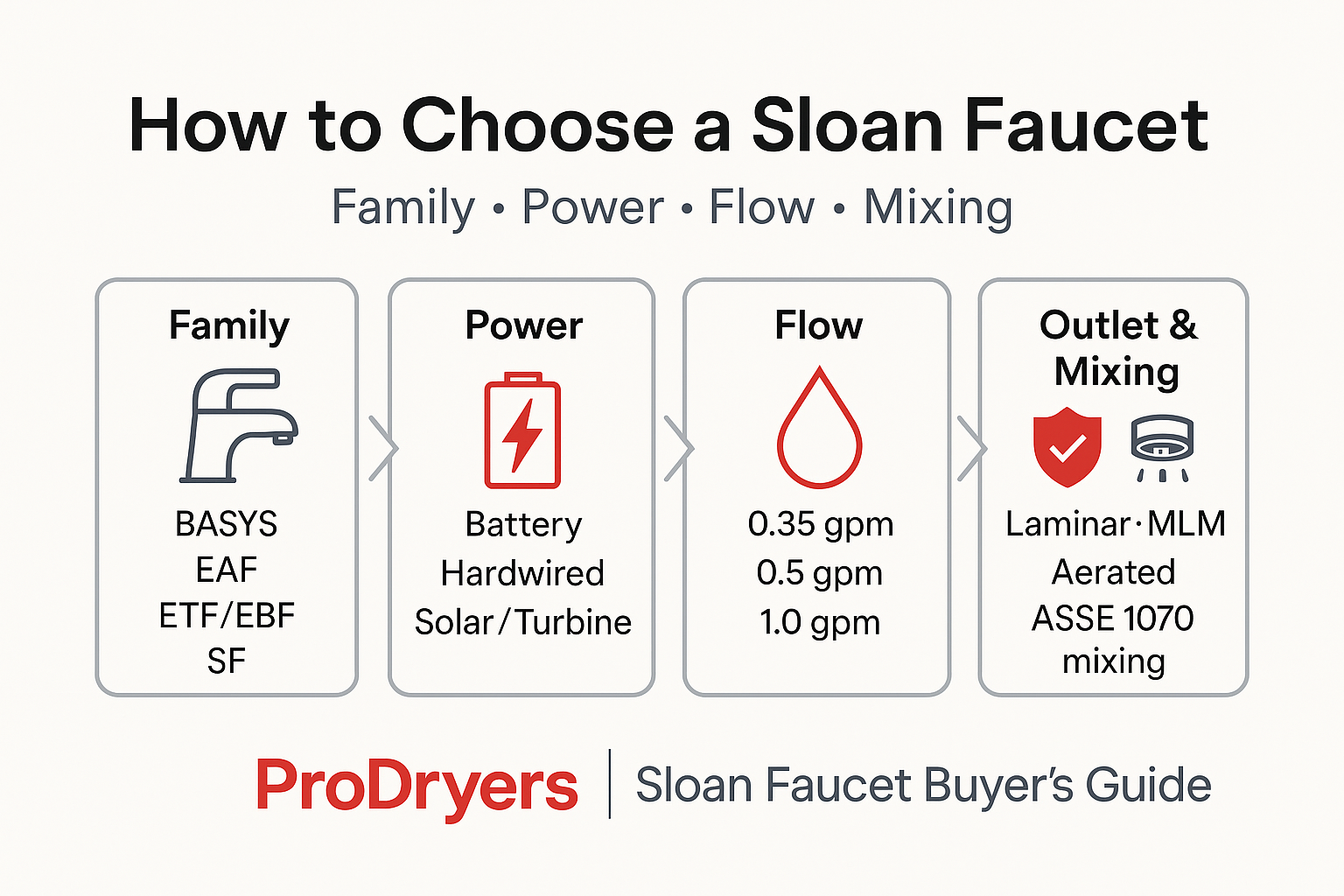
Step 1: Choose the faucet family

BASYS (EFX series)
Modular platform with Low, Mid, High, and Wall body options. Above deck service access is fast and safe. Power choices include battery, hardwired, solar, and turbine. Optional LCD and guided handwashing in select models. Hardwired units can add Bluetooth for the Sloan Connect app.
Optima EAF series
Clean, integrated look with electronics inside the spout. Common flows are 0.35, 0.5, and 1.0 gpm. Outlets include multi-laminar, laminar, and aerated. Power options include battery, hardwired, and solar on select models.
Optima ETF and EBF series
Classic Optima with a below deck control box. Available with battery or transformer power. Good for retrofits and for facilities that want service access under the deck.
SF series
Reliable workhorse options with battery or plug in transformer kits. Easy parts availability and multiple spout styles.
Quick platform comparison
Step 2: Mounting and body geometry
Deck mount is the most common style. BASYS also offers a wall mount version. Body height matters. Low bodies help control splash on shallow sinks. High bodies increase clearance for deeper bowls and higher rims. Always verify spout reach so the water column lands near the center of the bowl.
Step 3: Select the power source
Your power choice affects install complexity and lifecycle cost.
Outlet types
Laminar provides a clear, non aerated stream that many healthcare specs prefer. Multi-laminar uses bundled streams to reduce splash across a wide range of sink geometries. Aerated adds air for a softer feel and is common in office and hospitality settings.
Step 4: Mixing and scald protection
If you have both hot and cold supplies, include a mixing solution. Sloan offers back check tees for simple blends with pre tempered supply. For code driven scald protection, specify an ASSE 1070 thermostatic mixing valve sized for lavatory flow.
Step 5: Connected features and commissioning
Many hardwired BASYS and Optima EAF faucets can add a Bluetooth module for the Sloan Connect app. This makes it easy to set sensor range, adjust timeouts, schedule line flush, and apply consistent settings across many rooms. It also shortens commissioning time on large projects.
Step 6: Maintenance and lifecycle planning
Standardize parts across a campus to reduce downtime. Keep spray heads for your common flows. Stock at least one control module and sensor kit per bank of faucets for SF and ETF or EBF families. For battery models, set a preventive replacement interval so you avoid nuisance outages. Train staff to clean filters and flush lines as part of routine work.
Step 7: Common mistakes to avoid
Picking a tall spout for a shallow sink and creating splash complaints
Forgetting to add mixing valves and failing inspection
Choosing battery in high traffic restrooms and facing frequent battery changes
Skipping connected features and later wishing you had line flush controls
Use cases and quick picks
Healthcare
Hardwired power, 0.35 gpm laminar, thermostatic mixing to ASSE 1070, line flush enabled. BASYS or Optima EAF is typical.
Education
Battery or turbine, vandal resistant outlets, 0.5 gpm for throughput and comfort.
Office and hospitality
Mid body EAF or BASYS, 0.5 gpm MLM or aerated depending on desired feel.
Foodservice and public spaces
Robust SF or EAF, consider higher flow where allowed to speed hand washing. Choose outlets that minimize splash for your exact sink shape.
Real world example
Empower Field at Mile High in Denver upgraded to sensor activated Sloan faucets and water efficient flush valves across stadium restrooms. The project included BASYS EFX 250 and Optima EBF 187 faucets along with sensor operated solar powered flushometers. The venue reported large water savings per game along with better hygiene and reduced maintenance. This is a good illustration of matching faucet families and power choices to traffic, then planning for durability and service. The switch to Sloan products, Empower Field is estimated to save 277,000 gallons of water during each Broncos game. With 10 games per year, that amounts to a little under 3 million gallons saved per season. And that doesn’t even include the additional 300 events the stadium hosts on a yearly basis, including concerts, dances, and even the Democratic National Convention. Read the full case study from Sloan.
Decision matrix to speed selection
Installation and commissioning checklist
- Confirm sink hole pattern and deck thickness
- Verify power location or transformer placement if hardwired
- Select the correct flow and outlet to meet local code and user expectations
- Add mixing valve or back check tee where required
- For Bluetooth setups, add the adapter and use the Sloan Connect app to configure settings
- Record final timeouts, line flush intervals, and sensor ranges for maintenance records
Maintenance plan template
- Stock two to four common spray heads by flow for each bank of faucets
- Keep one sensor and one control module on hand for ETF, EBF, or SF families
- Set a preventive battery replacement schedule based on your traffic counts
- Train staff to clean inlet screens and replace outlet kits as needed
Pricing and project quotes
Most facilities save money by standardizing across one faucet family and bundling power supplies, mixing valves, and spare parts in a single quote. Call 888-503-7937 for a freight optimized quote that aligns with your flow targets, commissioning plan, and installation timeline.
FAQs
Which Sloan faucet family should I choose first?
Start with the platform family that fits your project. BASYS for premium and healthcare, Optima EAF for mainstream commercial, Optima ETF or EBF for retrofits with a below deck control box, and SF series for value and easy service.
What flow rate is best for my faucets?
Choose 0.35 gpm for water savings and many healthcare specs, 0.5 gpm for most commercial restrooms, and 1.0 gpm where local code allows and a stronger user perceived flow is preferred.
When should I use laminar vs aerated vs multi laminar outlets?
Use laminar for non aerated flow in healthcare and lab settings. Multi laminar and aerated are common in commercial restrooms. Pick based on splash control and user feel.
What power source should I pick for a Sloan faucet?
Battery is simplest for retrofits and low traffic areas. Hardwired is best for high traffic facilities and Bluetooth setup. Solar or turbine power works well in high use locations where energy harvesting is practical.
Do I need a mixing valve or can I use a tee?
If you have hot and cold supplies and require scald protection, specify an ASSE 1070 thermostatic mixing valve. For pre tempered supply or simple blending, a Sloan back check tee can be used where appropriate.
Can I configure Sloan faucets with my phone?
Yes. Compatible hardwired BASYS and Optima EAF faucets can be configured with the Sloan Connect app when equipped with the Bluetooth adapter, allowing adjustments to sensor range, timeouts, and line flush.
How do I avoid splash and user complaints?
Match body height and spout reach to sink geometry. Low body spouts suit shallow sinks. Mid or High bodies work with deeper basins. Select an outlet that reduces splash for your sink shape.
What is the best way to save money on Sloan faucets?
Standardize across a faucet family and request a bundle quote that includes power supplies, mixing valves, and spare parts. Call 888-503-7937 for a freight optimized quote tailored to your ship to and quantities.