
Commercial Restroom Sinks and Faucets: The Complete Buyer’s Guide
Posted by Anthony DiCicco on May 6th 2026
Commercial Restroom Sinks and Faucets Buying Guide
Choosing commercial restroom sinks and faucets is not about picking individual fixtures. It is about building a coordinated handwashing system that works in real commercial restrooms.
The biggest commercial restroom sink problems usually happen before installation even begins. Poor faucet reach, incompatible sink configurations, bad user flow planning, and mismatched components create more long-term issues than the actual products themselves.
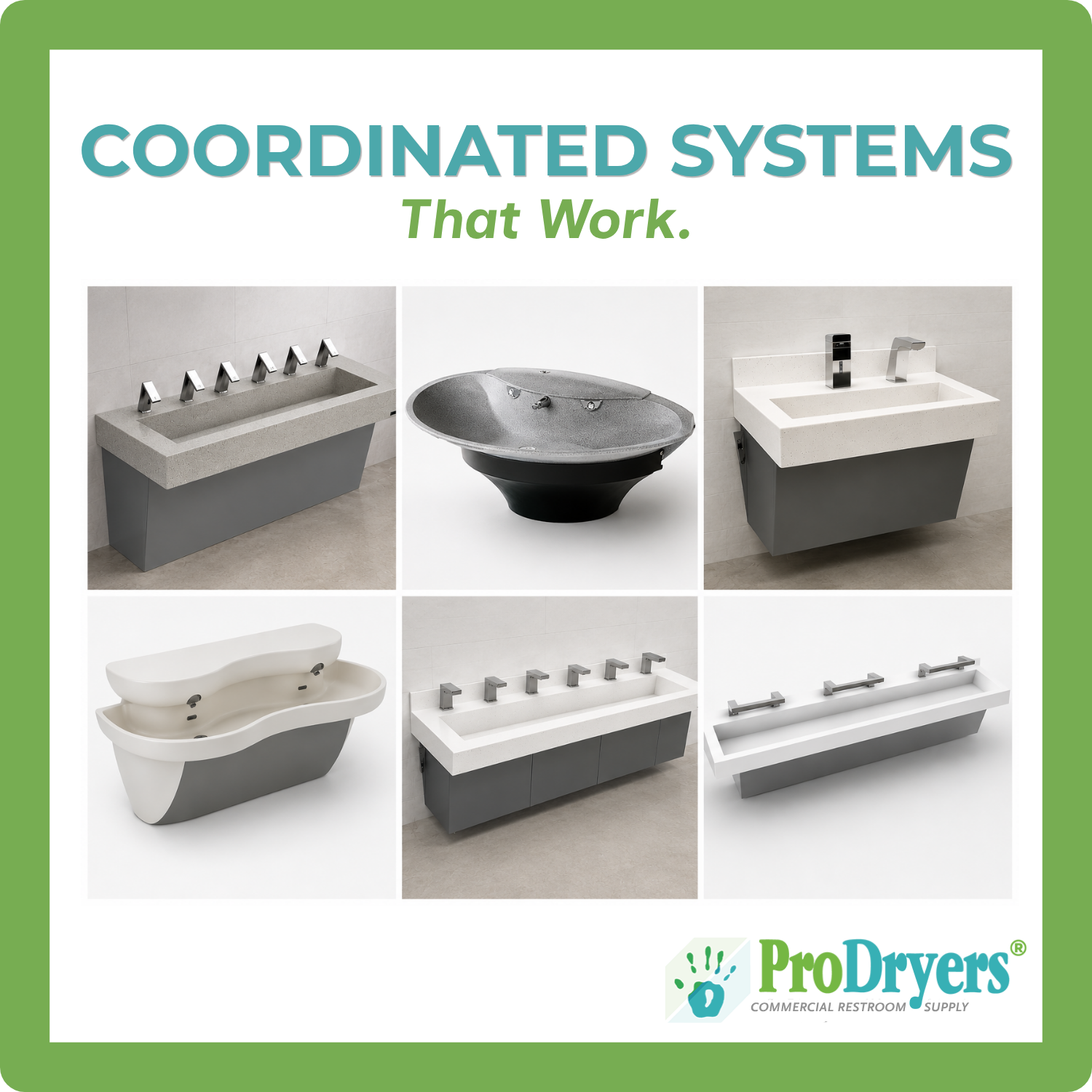
This guide explains the major types of commercial sinks, faucets, integrated sink systems, wash fountains, and lavatory systems so contractors, plumbers, facility managers, architects, spec writers, and general buyers can make a better decision before anything ships.
Quick Answer: What Is the Best Commercial Sink and Faucet Setup?
The best commercial sink and faucet setup depends on the facility, but most projects fall into a few proven configurations.
- Best overall for most facilities: Standard commercial sink with a touchless faucet
- Best for high-traffic restrooms: Integrated sink systems or wash fountains
- Best for retrofit projects: Existing-compatible sink with a properly matched faucet
- Best for premium restroom design: Sloan, Bradley, or Zurn integrated lavatory systems
- Best for facility-wide sink coverage: Elkay commercial sinks
If you are unsure where to start, a standard commercial sink paired with a touchless faucet is still the safest choice for most commercial restrooms. It is flexible, familiar to installers, and easier to maintain long term.
Commercial Sink and Faucet Comparison Table
| Sink Type | Best For | Main Advantage | Main Watchout |
|---|---|---|---|
| Standard Commercial Sink | Offices, retail, restaurants, retrofits | Flexible, serviceable, lower risk | Faucet reach and basin size must match |
| Integrated Sink System | Airports, Class A offices, modern restrooms | Coordinates soap, water, and drying | Higher cost and more planning required |
| Wash Fountain | Schools, stadiums, factories, industrial spaces | Handles multiple users quickly | Not ideal for privacy or premium design spaces |
| Multi-Station Lavatory System | High-use public and institutional restrooms | Cleaner and more coordinated than separate sinks | Requires proper user flow planning |
| Faucet Type | Best For | Main Advantage | Main Watchout |
|---|---|---|---|
| Touchless Faucet | Most commercial restrooms | Hygiene, water control, modern user expectation | Power and sensor setup must be planned |
| Metering Faucet | Schools and budget-conscious facilities | Water control without electronics | Less intuitive than touchless |
| Manual Faucet | Low-use or budget-driven areas | Simple and reliable | Feels outdated in many public restrooms |
Standard Commercial Restroom Sinks
Standard commercial sinks are still the most common choice for commercial restrooms because they are flexible, familiar, and easier to service than fully integrated systems.
Browse options in our commercial restroom sinks category.
This setup works best when you are replacing existing fixtures, working within a fixed layout, controlling budget, or trying to avoid overcomplicating the project.
The biggest mistake with standard sinks is treating the sink and faucet as separate decisions. Faucet reach, basin depth, backsplash height, hole spacing, ADA clearance, soap placement, and hand drying location all affect whether the station works well.
Commercial Wash Fountains
Wash fountains are not standard sinks. They are high-throughput handwashing stations designed to move multiple users through a restroom quickly.
Browse options in our commercial wash fountains category.
Wash fountains are best for schools, stadiums, industrial facilities, locker rooms, factories, and other environments where volume matters more than individual privacy or premium design.
Strong opinion: if your problem is user volume, a wash fountain can outperform a row of individual sinks. But if your problem is premium appearance or personal space, it is probably the wrong solution.
Integrated All-In-One Lavatory Sink Systems
Integrated lavatory systems combine multiple handwashing functions into one coordinated station. These systems usually combine a basin, faucet, soap dispenser, and sometimes hand drying into a single engineered layout.
Browse options in our all-in-one lavatory sink systems category.
Integrated systems are strongest in airports, Class A office buildings, healthcare facilities, high-end public restrooms, and modern commercial spaces where cleanliness, appearance, and user flow matter.
They are not automatically better for every project. In a tight retrofit, a fully integrated system can create more problems than it solves if the layout, utilities, mounting, access, and maintenance plan are not verified upfront.
Best Commercial Sink and Faucet Products by Use Case
Best Overall Setup for Most Commercial Restrooms
A standard commercial sink with a touchless faucet is still the best overall setup for most facilities.
This setup gives buyers maximum flexibility, easier maintenance, broad product availability, and fewer long-term service risks.
Start with commercial restroom sinks and commercial restroom faucets.
Best for High-Traffic Restrooms
For heavy traffic, consider integrated sink systems or wash fountains. Integrated systems work well when cleanliness and premium user experience matter. Wash fountains work well when speed and durability are the priority.
Start with all-in-one lavatory systems or commercial wash fountains.
Best for Retrofit Projects
For retrofits, the safest approach is usually a standard sink and compatible touchless faucet. Do not assume a new faucet will fit the existing sink or countertop. Confirm hole spacing, mounting, power, spout reach, and water supply before ordering.
Best for Spec-Driven Projects
For architect-driven or engineer-specified projects, coordinated systems from Sloan, Bradley, or Zurn can reduce compatibility issues and simplify submittals.
Top 5 Commercial Sink and Faucet Combos Compared
1. Standard Commercial Sink with Sloan Touchless Faucet
This is the safest proven setup for most commercial restrooms. It is familiar to contractors, serviceable for maintenance teams, and flexible enough for offices, retail, restaurants, and public restrooms.
Browse commercial restroom sinks and Sloan automatic touchless faucets.
Watch out for faucet reach. A high-quality faucet can still create a bad user experience if the water stream hits the wrong part of the basin.
2. Integrated Sloan Sink System
Sloan integrated systems are best when the project needs a coordinated soap, water, and drying experience instead of separate products installed independently.
Browse Sloan sink systems.
These systems are strongest in high-end commercial spaces, airports, office buildings, and public restrooms where appearance, cleanliness, and system consistency matter.
3. Existing Sink with Chicago Faucets Sensor Faucet
This is a strong retrofit approach when the sink is staying in place but the faucet needs to be upgraded to touchless operation.
Browse Chicago Faucets electronic sensor faucets.
The key is measurement. Retrofit jobs fail at the verification stage, not the product stage. Confirm hole configuration and mounting before anything ships.
4. Standard Sink with HydroTek Touchless Faucet
This is a practical budget-conscious setup for facilities that want touchless functionality without moving into premium faucet pricing.
Browse HydroTek automatic faucets.
It is a good fit for small businesses, schools, and cost-sensitive projects, but buyers should understand that lower upfront cost may come with different long-term maintenance expectations.
5. Bradley Multi-User or Wash Fountain System
Bradley systems are best when the problem is user volume, durability, or institutional use. This is not about creating the most decorative restroom. It is about moving users through efficiently with a system built for heavy use.
Browse Bradley lavatory systems and commercial wash fountains.
Sloan Sink Systems Explained
Sloan does not make one type of sink system. Sloan offers multiple platforms for different restroom environments, from fully integrated high-end systems to specialized handwashing and scrub sink applications.
The mistake is treating all Sloan systems as interchangeable. They are not. Each Sloan sink family solves a different type of problem.
FLITE-DEC Sink System
FLITE-DEC is Sloan’s high-performance integrated sink system for demanding, high-traffic restrooms. It is designed for environments where durability, uptime, and water containment matter.
This system is best for airports, stadiums, transportation hubs, and high-volume public facilities. It is not just a sink. It is a coordinated handwashing station, so buyers need to think about installation access, maintenance, soap management, and long-term service before specifying it.
AER-DEC Integrated Sink Systems
AER-DEC is one of Sloan’s most recognized integrated sink systems. It is designed to combine soap, water, and hand drying into one clean, coordinated handwashing experience.
AER-DEC is strongest in Class A offices, corporate restrooms, airports, and design-forward commercial spaces. It performs best when planned early in the project, not forced into a retrofit after the layout is already locked.
DS Series Lavatory Systems
The Sloan DS Series is a practical lavatory system choice for durable multi-station layouts. It is better suited to institutional and high-use environments than decorative restroom design.
ELB Series Lavatory Systems
The ELB Series fits basic commercial restroom installations where a reliable lavatory system is needed without moving into a premium integrated platform.
ELGR Series Lavatory Systems
The ELGR Series is a stronger fit for modern multi-user commercial restrooms that need a cleaner, more coordinated lavatory appearance without necessarily requiring a full all-in-one system.
EW Series Lavatory Systems
The EW Series is useful when wall-mounted efficiency and space planning matter. It can be a practical choice for smaller restrooms, retrofits, and ADA-conscious layouts where space is limited.
ELS Series Lavatory Systems
The ELS Series is a streamlined commercial lavatory option for projects that need a clean, functional system while keeping budget and complexity under control.
ELC Series Lavatory Systems
The ELC Series is best understood as a configurable commercial lavatory option for projects that need layout flexibility without moving fully into an integrated sink system.
EWF Series Lavatory Systems
The EWF Series is closer to a high-volume wash environment. It is useful when multiple users need access and the facility needs durability, throughput, and a more organized handwashing layout.
EHS-1000 Series Hand-Washing Sink
The EHS-1000 Series is designed for dedicated handwashing applications. It is a better fit for targeted handwashing stations, food service support areas, back-of-house spaces, and controlled environments than a general restroom lavatory.
ESS-2000 and ESS-3000 Scrub Sinks
The ESS-2000 and ESS-3000 Series are specialized scrub sink systems. These should not be compared to standard restroom sinks. They are intended for healthcare, surgical, and hygiene-critical environments where handwashing protocols are more demanding.
In simple terms: use Sloan integrated systems when coordination matters, Sloan lavatory systems when you need a commercial multi-user solution, and Sloan scrub or hand-washing sinks when the application is specialized.
Bradley Wash Fountains Explained
Bradley wash fountains are built for throughput, durability, and simplified handwashing in high-volume environments. They are not meant to replace standard sinks in every restroom.
BradMate Wash Fountains
BradMate wash fountains are a practical option for budget-conscious high-traffic facilities that still need multi-user handwashing. They are commonly considered for schools, light commercial spaces, and institutional projects where cost matters.
Circular Wash Fountains
Circular wash fountains are the classic high-throughput solution. They allow users to access the fixture from multiple sides, making them strong choices for stadiums, large schools, factories, and locker rooms.
Semi-Circular Wash Fountains
Semi-circular wash fountains mount against a wall and provide multi-user handwashing without requiring a full open floor layout. They are often the practical compromise between capacity and space efficiency.
Corner Wash Fountains
Corner wash fountains are layout-driven solutions. They make use of corner space that might otherwise be wasted, especially in smaller restrooms or retrofit environments.
Deep Bowl Wash Fountains
Deep bowl wash fountains help contain water and reduce splash. Bowl depth is one of the most overlooked factors in wash fountain performance, especially in schools and industrial environments.
Shallow Bowl Wash Fountains
Shallow bowl wash fountains can improve access and user comfort, but buyers need to consider splash control and the age or height of the expected users.
Extra Height Wash Fountains
Extra height wash fountains are designed for environments where standard height is not the best fit. Height should match the user base. Incorrect height creates usability problems even when the fixture itself is correct.
Multi-Fount Wash Fountains
Multi-Fount systems are for extremely high-volume environments that need multiple washing positions in one coordinated solution. These are throughput products first.
Pre-Assembled Wash Fountains
Pre-assembled wash fountains can reduce installation time and help limit field errors. They are useful on projects with tight schedules or multiple repeated installations.
Wash Fountains by Material
Material matters. Stainless steel is often selected for durability and high-abuse environments. Solid surface materials are often selected when appearance, cleanability, and a more finished look matter.
The real question is not “which wash fountain looks best?” It is “which wash fountain matches the user volume, layout, maintenance plan, and abuse level?”
Bradley Lavatory Sink Systems Explained
Bradley lavatory systems sit between basic commercial sinks and full wash fountain solutions. They are stronger, more coordinated, and more application-specific than a typical sink and countertop setup.
Multi-Station Sinks
Bradley multi-station sinks are designed to serve more users with fewer individual fixtures. They are strong choices for schools, stadiums, factories, transportation facilities, and other high-use restrooms.
Advocate
Bradley Advocate is an integrated handwashing concept that combines soap, water, and drying at one station. It is useful to understand when comparing all-in-one systems, but availability should be verified before positioning it as a current recommendation.
Express
Bradley Express is one of the most practical Bradley lavatory systems for commercial restrooms. It is a strong choice for schools, offices, public restrooms, and general commercial applications that need durability without moving into a premium design package.
Frequency
Frequency is Bradley’s accessibility-focused lavatory system. It is especially useful in mixed-user environments where adults, children, and users with disabilities all need practical access.
OmniDeck
OmniDeck is a coordinated solid surface deck solution. It is best for projects that want a cleaner, more controlled lavatory deck without relying on pieced-together field fabrication.
Terreon
Terreon is Bradley’s durable solid surface material used across many Bradley systems. It is a strong choice when cleanability, durability, repairability, and long-term performance matter more than lowest upfront cost.
Verge
Bradley Verge is the premium design-forward lavatory system. It is best for Class A offices, airports, hospitality, corporate campuses, and upscale public restrooms where appearance and user experience are part of the project goal.
In simple terms: choose Express for practical commercial durability, Frequency for mixed-height accessibility, OmniDeck for coordinated solid surface decks, Terreon for material performance, and Verge for premium design.
Zurn Sundara Handwashing System
The Zurn Sundara Handwashing System is an all-in-one commercial restroom solution that integrates a solid surface basin, sensor-operated faucet, and soap dispenser into one coordinated unit.
Browse Zurn commercial lavatory products.
Sundara is built for higher-end commercial spaces where appearance, installation efficiency, and system coordination all matter. It helps reduce the risk of choosing a sink, faucet, and soap dispenser that do not work well together.
Sundara Basin Styles
- Reef: Wide opening, sweeping basin, and broad back shelf for a more open user experience
- Drift: Organic low-profile design with a rising backsplash to help contain water
- Float: Minimalistic design focused on a seamless modern look
- Tide, Surf, and Inlet: Softer, smoother designs suited for demanding environments such as schools and healthcare facilities
Where Sundara Works Best
- Class A office buildings
- Airports and transportation facilities
- Healthcare restrooms
- Architect-driven projects
- Modern commercial spaces that need a coordinated handwashing system
Sundara is not competing with a basic sink. It is competing with poor coordination, installation mistakes, and long-term maintenance problems caused by separate components that were never designed as a system.
Elkay Commercial Sinks Explained
Elkay is different from Sloan, Bradley, and Zurn. Sloan, Bradley, and Zurn are often selected for engineered systems. Elkay is often selected for reliable commercial sink infrastructure across the entire facility.
Elkay commercial sinks are used in healthcare facilities, schools, stadiums, restaurants, airports, office buildings, food service areas, utility rooms, classrooms, restrooms, and handwashing stations.
Elkay sinks are on our sister site at ProDrinkingFountains.com
Classroom Sinks
Elkay classroom sinks are built for education environments where durability, repeated use, and easy cleaning matter. They are used in schools, labs, training rooms, and shared learning spaces.
Food Service Sinks
Food service sinks are not restroom sinks. They are designed for commercial kitchens, food prep, sanitation, bar areas, and restaurant applications where cleaning and code requirements are much more demanding.
General Use Sinks
General use sinks are flexible commercial sinks for offices, retail spaces, light commercial use, and utility applications where a simple, dependable sink is needed.
Lavatory Sinks
Elkay lavatory sinks are the most relevant option for many commercial restrooms. They are practical for standard restroom layouts, retrofit projects, and applications where buyers want a durable sink that can pair with a wide range of faucets.
Parts and Accessories
Parts and accessories are easy to overlook, but they matter. Missing mounting hardware, incorrect drains, or the wrong accessory package can delay installation even when the sink itself is correct.
Scrub and Hand Wash Sinks
Scrub and hand wash sinks are specialized for hygiene-focused environments such as healthcare, labs, food service support areas, and controlled spaces. They should not be treated like general restroom lavatories.
Service and Utility Sinks
Service and utility sinks are built for cleaning, maintenance, janitorial work, and back-of-house use. They are work sinks, not public-facing design elements.
The real strength of Elkay is breadth. A facility can use Elkay across restrooms, kitchens, utility rooms, classrooms, and specialty handwashing areas while matching the sink to the application.
Commercial Faucet Types and Brands
Browse all options in our commercial restroom faucets category.
Touchless Faucets
Touchless faucets are the most recommended option for most public and commercial restrooms because they support hygiene, water control, and modern user expectations.
Metering Faucets
Metering faucets are useful where water control matters but electronics are not desired. They are common in schools and budget-conscious commercial projects.
Manual Faucets
Manual faucets are simple and reliable, but they can feel outdated in modern public restrooms. They are best for low-use or back-of-house spaces.
Commercial Faucet Brand Positioning
- Sloan faucets: Strong overall choice for reliability and serviceability
- Chicago Faucets: Strong for durability and retrofit applications
- HydroTek faucets: Practical budget-friendly touchless option
- Zurn faucets: Strong for spec-driven projects and coordinated plumbing packages
- Bradley faucets: Strong for institutional and Bradley system applications
Common Commercial Sink and Faucet Mistakes
- Wrong faucet reach: The faucet water stream hits the wrong part of the basin and causes splash.
- Wrong hole spacing: The faucet does not match the sink or countertop configuration.
- Poor soap placement: Soap drips outside the basin or creates unnecessary cleanup.
- Bad drying layout: Users drip water across the restroom while walking to a dryer or towel dispenser.
- Overusing integrated systems: Integrated systems are excellent when planned correctly, but not every retrofit can support them.
- Ignoring maintenance access: If the maintenance team cannot service the system easily, it becomes a long-term problem.
ADA and Accessibility Considerations
ADA compliance depends on the full installation, not just the product. Sink height, knee clearance, reach range, faucet operation, drain protection, and surrounding clear floor space all matter.
A product can be ADA-capable and still be installed incorrectly. Always verify the final installed condition against project requirements and applicable codes.
Final Takeaway: What Should You Actually Choose?
If you need the safest choice for most facilities, start with a standard commercial sink and touchless faucet.
If you need high traffic performance, look at Bradley wash fountains, Bradley multi-station systems, Sloan lavatory systems, or Zurn integrated options.
If you need premium design and a coordinated user experience, compare Sloan AER-DEC, Sloan FLITE-DEC, Bradley Verge, and Zurn Sundara.
If you need facility-wide sink coverage, Elkay is one of the strongest places to start because their catalog covers restrooms, kitchens, classrooms, utility rooms, handwashing areas, and specialty applications.
Why Buyers Choose ProDryers
ProDryers works with contractors, plumbers, facility managers, architects, spec writers, and commercial buyers every day. We help customers avoid the real mistakes that cause project delays, poor restroom performance, maintenance headaches, and wrong product orders.
We do not just look at one product. We help think through the full handwashing station, including the sink, faucet, soap dispenser, hand dryer, paper towel placement, ADA requirements, installation conditions, and long-term maintenance.
Commercial Sink and Faucet FAQ
What is the best commercial restroom sink?
The best commercial restroom sink depends on the facility. Standard commercial sinks are best for most general restrooms, integrated systems are best for modern high-end spaces, wash fountains are best for high-volume restrooms, and Elkay commercial sinks are strong for broad facility-wide applications.
Are touchless faucets worth it in commercial restrooms?
Yes. Touchless faucets are usually worth it because they support hygiene, water control, and modern user expectations. The key is matching the faucet to the sink, power source, and maintenance plan.
When should I use a wash fountain instead of standard sinks?
Use a wash fountain when the restroom needs to move many users quickly, such as in schools, stadiums, factories, locker rooms, and industrial facilities. Do not use a wash fountain just because it is large. Use it when throughput is the real problem.
What is the advantage of an integrated sink system?
An integrated sink system coordinates the basin, faucet, soap dispenser, and sometimes hand dryer into one system. This can reduce water on floors, improve restroom appearance, and simplify specification, but it requires more planning than a standard sink setup.
What causes most commercial sink and faucet problems?
Most problems come from mismatched components, incorrect faucet reach, wrong hole spacing, poor soap or drying placement, and lack of maintenance planning. The product is often not the problem. The system design is.
About the Author
Anthony DiCicco is a commercial restroom product specialist and CEO of ProDryers with over 20 years of experience helping contractors, facility managers, architects, and commercial buyers select restroom products that fit real-world applications.