Comparison Guide: Dyson Airblade vs Excel Dryer XLERATOR
A Spec-Based Comparison for Architects and Designers
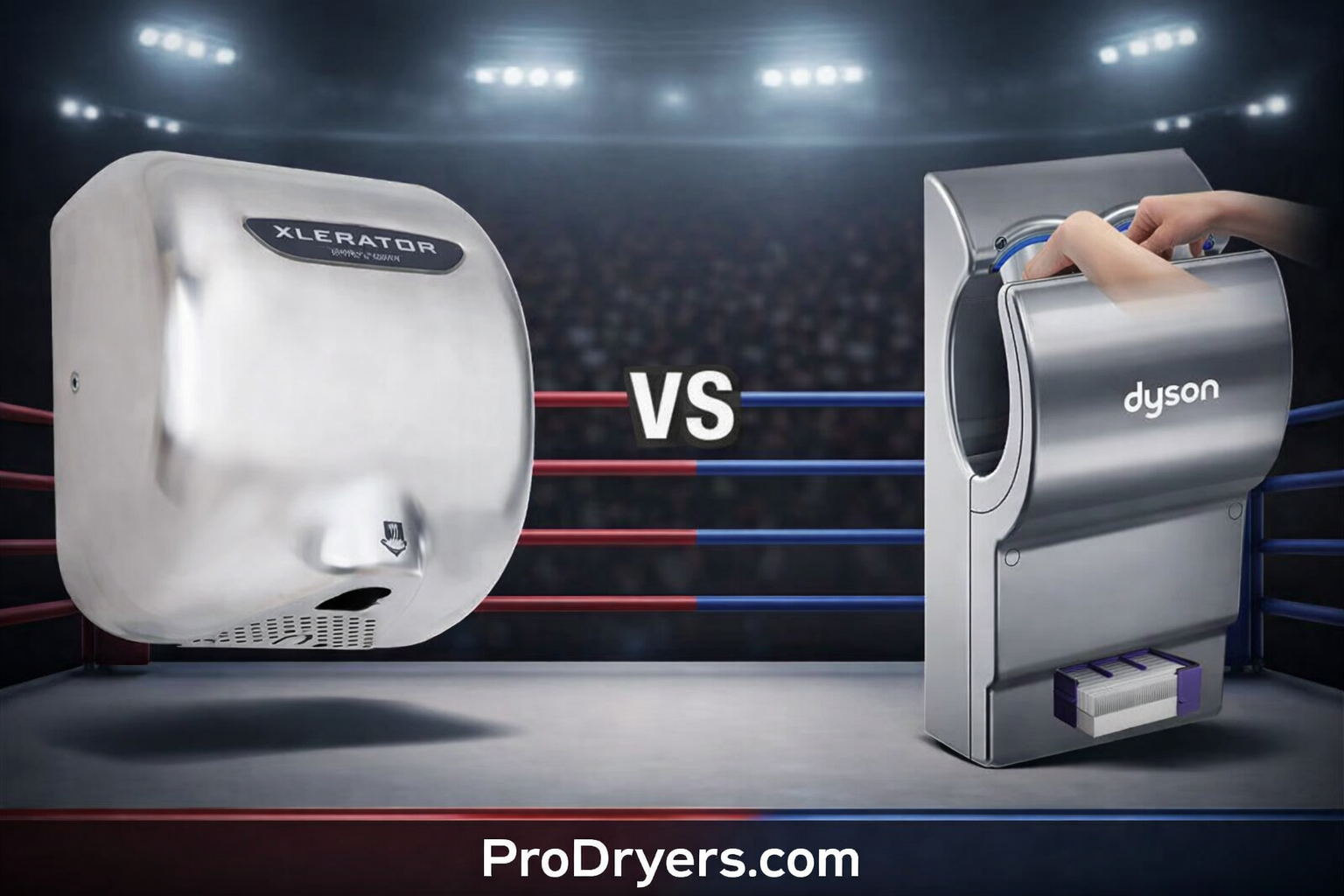
Comparing Dyson Airblade and XLERATOR hand dryers requires more than a brand-level discussion. These products are specified based on airflow method, sound expectations, energy use, electrical planning, spatial constraints, and ADA considerations. A meaningful comparison must evaluate specific models and configurations, not general product families.
This guide compares commonly specified Dyson Airblade wall-mounted models against XLERATOR hand dryers, using the XLERATOReco Eco configuration with HEPA (-H) as the primary Excel Dryer comparison. ThinAir and Wash + Dry systems are addressed separately where design intent differs.
Models included in this comparison
Dyson Airblade wall-mounted models
- Airblade AB14
- Airblade HU02
- Airblade 9kJ
Excel Dryer models
- XLERATOR Eco with HEPA (-H) and 1.1 noise reduction nozzle
- ThinAir with HEPA
Note on terminology: While most people reference “XLERATOR,” the Eco configuration without heat and with HEPA (-H) is the most appropriate comparison to Dyson Airblade models, which do not use resistive heating elements. We mostly refer to the XLERATOReco version with HEPA filtration installed.
Core design difference: blade drying vs high-speed airflow
Dyson Airblade hand dryers use sheets of high-velocity air to physically scrape water from hands. Drying performance is achieved without a heating element and relies on air speed and blade geometry.
XLERATOR hand dryers use focused high-speed airflow to blow water off hands. In the Eco configuration, resistive heat is disabled to reduce energy consumption and electrical load while maintaining fast drying performance.
Because Dyson Airblade models do not use heat, the XLERATOReco Eco configuration provides the most accurate comparison baseline.
At-a-glance comparison
Dyson Airblade AB14
Dry time: ~10–12 sec
Power range: ~1,150–1,600 W
Depth: ~9 3/4 in
HEPA: Standard
Warranty: 5-year
Dyson Airblade HU02
Dry time: ~12 sec
Power range: ~1,000 W
Depth: ~4 in
HEPA: Standard
Warranty: 5-year
Dyson Airblade 9kJ
Dry time: ~10 sec Max
Power range: ~650–900 W
Depth: ~4 in
HEPA: Standard
Warranty: 5-year
XLERATOR Eco with HEPA (-H)
Dry time: ~10 sec
Power range: ~425–530 W
Depth: ~6 11/16 in
HEPA: Installed
Warranty: 7-year
ThinAir with HEPA
Dry time: ~14 sec
Power range: ~330–400 W
Depth: ~3 15/16 in
HEPA: Installed
Warranty: 7-year
Model specification details
Dyson Airblade AB14
Hands-in blade-style drying
Drying method
Blade-style air sheets
Heating element
None
Sound
Approximately 81 dB sound power
ADA and spatial notes
Generally considered ADA compliant due to cane-detectable, floor-standing design
Not designed to be recessed
Typical specification drivers
High-traffic restrooms where blade drying consistency and hygiene are priorities
Dyson Airblade HU02
Hands-under blade-style drying
Drying method
Blade-style air sheets
Heating element
None
Sound
Approximately 79 dB sound power with lower published sound pressure at distance
ADA and spatial notes
Shallow wall-mounted profile designed around the 4-inch protrusion threshold
Typical specification drivers
Wall-mounted applications where depth control and visual simplicity are important
Dyson Airblade 9kJ
Low-energy blade-style drying
Drying method
Blade-style air sheets
Heating element
None
Sound
Approximately 77 to 79 dB depending on operating mode
ADA and spatial notes
Shallow wall-mounted profile similar to the HU02
Typical specification drivers
Projects prioritizing reduced energy use over maximum drying speed
XLERATOR Eco with HEPA (-H) and 1.1 noise reduction nozzle
High-speed airflow drying without heat
Drying method
High-speed focused airflow
Heating element
None
Sound
Approximately 65 to 75 dB adjustable with 1.1 nozzle installed
ADA and spatial notes
Deeper wall-mounted profile
Recess kit may be used where wall projection must be reduced, depending on layout
Typical specification drivers
High-traffic restrooms prioritizing fast drying, airflow adjustability, and low connected load
ThinAir with HEPA
Low-profile airflow drying
Drying method
High-speed focused airflow
Heating element
Optional, can be disabled
Sound
Approximately 66 to 74 dB adjustable
ADA and spatial notes
Very shallow wall projection
Commonly selected where reduced depth simplifies ADA coordination
Typical specification drivers
Space-constrained or sound-sensitive environments where reduced depth outweighs maximum throughput
Energy use and electrical planning
None of the Dyson Airblade wall-mounted models use a resistive heating element. As a result, energy consumption is driven primarily by motor load and run time rather than heat output.
The Airblade AB14 operates at a higher instantaneous wattage, particularly at higher voltages, which can influence panel loading in larger restroom cores.
The Airblade HU02 reduces overall power draw while maintaining blade-style drying performance, making it a common choice where electrical capacity is more constrained.
The Airblade 9kJ prioritizes lower energy use per dry cycle. This is achieved through reduced power operation and longer dry times when set to lower-energy modes.
The XLERATOR Eco with HEPA (-H) eliminates resistive heat and limits total wattage, resulting in a significantly lower connected load than standard heated XLERATOR configurations. This can simplify electrical planning in multi-stall restrooms and, depending on design standards, support a higher number of fixtures per electrical circuit.
The ThinAir offers very low power draw when heat is disabled, with longer published dry times as the tradeoff.
For many projects, connected load, circuit availability, and panel capacity are more influential design considerations than per-use energy cost alone.
Model-by-model comparison highlights
Dyson Airblade AB14 vs XLERATOR Eco with HEPA (-H)
Both models are commonly specified for high-traffic environments where fast drying and filtration are priorities.
The Dyson Airblade AB14 uses blade-style airflow and includes HEPA filtration as standard. Its hands-in, floor-standing design is generally considered ADA compliant due to cane detectability. The AB14 is not designed to be recessed, so layout planning focuses on placement and circulation paths rather than wall modification.
The XLERATOR Eco with HEPA (-H) uses high-speed airflow and eliminates resistive heat to reduce connected electrical load. When configured with the 1.1 noise reduction nozzle, sound output can be moderated while maintaining fast published dry times. As a wall-mounted unit, projection depth and circulation paths must be reviewed during layout coordination.
Dyson Airblade HU02 vs XLERATOR Eco with HEPA (-H)
These models are often compared when wall-mounted dryers are required and HEPA filtration is specified.
The HU02 offers a shallow wall profile designed around the 4-inch protrusion threshold. It uses blade-style drying, does not rely on a heating element, and is frequently selected where depth control and visual simplicity are priorities.
The XLERATOR Eco with HEPA (-H) provides greater airflow adjustability and a lower connected load. In installations where wall projection must be reduced, a recess kit may be used, depending on wall construction and overall layout constraints.
Dyson Airblade 9kJ vs XLERATOR Eco with HEPA (-H)
This comparison typically arises when energy use is a primary design consideration.
The Dyson Airblade 9kJ emphasizes reduced energy consumption within the Airblade range while retaining blade-style drying and HEPA filtration. Its wall-mounted depth is similar to the HU02, which can simplify coordination in circulation paths.
The XLERATOR Eco with HEPA (-H) operates at a lower wattage range than standard XLERATOR configurations while maintaining fast published dry times. The tradeoff is increased physical depth unless a recessing approach is incorporated into the wall design.
ThinAir with HEPA vs Dyson Airblade wall-mounted models
ThinAir with HEPA is most often evaluated when reduced wall projection is the dominant constraint.
Compared to the AB14, HU02, and 9kJ, ThinAir offers the shallowest profile and adjustable sound characteristics. Published dry times are longer than both XLERATOR Eco and most Airblade models, but depth control and sound management are often the deciding factors in sensitive or space-constrained environments.
Wash and Dry systems
A separate design category
Wall-mounted hand dryers and sink-integrated Wash and Dry systems solve different restroom design problems. They should be evaluated independently and not compared using the same criteria.
Dyson Airblade Wash and Dry
Available models include the Short (WD04), Tall (WD05), and Wall-mounted (WD06) configurations.
These systems allow users to wash and dry their hands at the sink, keeping water contained in the basin rather than dripping onto the floor. HEPA filtration is standard, and drying is achieved without a resistive heating element.
Dyson publishes an approximate dry time of 14 seconds. Successful specification requires attention to sink geometry, basin material, spacing between units in multi-unit layouts, and surface compatibility.
Wash and Dry systems are commonly selected where floor cleanliness, space efficiency, and traffic flow are primary concerns.
XLERATORsync with D13 Sink System
The XLERATORsync system integrates a hand dryer directly into a dedicated sink assembly rather than mounting the dryer to the wall independently.
The D13 sink system features a solid surface basin with a channel drain and a concealed plumbing enclosure. eHEPA filtration is standard, and sound output is adjustable, with a published range of approximately 68 to 78 dB.
Because the dryer, sink, and enclosure are part of a coordinated system, planning focuses on wall mounting, plumbing coordination, and maintenance access. Warranty coverage is split between the hand dryer and the sink components.
Specification note
Wash and Dry systems introduce sink geometry, plumbing coordination, and spacing requirements that do not apply to wall-mounted hand dryers. For that reason, they should be specified as a separate category rather than treated as substitutes for wall-mounted dryers.
Warranty comparison
- Dyson Airblade wall-mounted models 5-year limited warranty
- Dyson Wash and Dry 5-year limited warranty on dryer components
- XLERATOR and ThinAir 7-year limited warranty
- XLERATORsync system 7-year warranty on hand dryer and 3-year warranty on sink
Resources for Download, Printing or Sharing
Frequently Asked Questions
Is it fair to compare Dyson Airblade models to a standard XLERATOR without HEPA
No. A fair comparison uses XLERATOR Eco with HEPA (-H) because Dyson Airblade models include HEPA filtration as standard.
Why focus on XLERATOR Eco instead of the standard heated XLERATOR
Dyson Airblade wall-mounted models do not use resistive heating. The Eco configuration aligns most closely with Dyson’s energy and electrical profile.
What does XLERATOR Eco with HEPA (-H) and 1.1 nozzle mean
It refers to a no-heat XLERATOR configuration with the HEPA option installed and the 1.1 inch nozzle selected to reduce perceived noise.
Is the Dyson Airblade AB14 ADA compliant
The AB14 is generally considered ADA compliant because it is cane-detectable. Final compliance depends on placement and circulation paths.
Can the AB14 be recessed
No. The AB14 is not designed to be recessed.
When is a recess kit considered for XLERATOR
A recess kit may be evaluated when wall projection must be reduced in circulation paths. This depends on layout and wall construction.
Are Wash and Dry systems comparable to wall-mounted dryers
No. Wash and Dry systems integrate sink and drying functions and must be evaluated as a separate system category.
About the Author
Anthony DiCicco is the CEO of ProDryers and contributes educational content on commercial hand dryers, restroom accessories, and product selection for facilities and contractors. Learn more about the people behind ProDryers on our Meet the Team page.